Enhances Vetting And Oversight Of Workers Cleared For Secure Areas
On a bipartisan voice vote, the U.S. Senate Commerce Committee on Wednesday approved S. 2361, the Airport Security Enhancement and Oversight Act, which had been jointly introduced by Senators John Thune (R-SD) and Bill Nelson (D-FL), the chairman and ranking member of the Senate Commerce, Science, and Transportation Committee, along with Sens. Kelly Ayotte (R-NH) and Maria Cantwell (D-WA) the chair and ranking member of the Aviation Subcommittee.
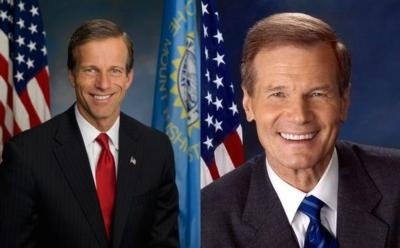
“To secure sensitive airport areas, access must be limited to properly credentialed airport employees who have been thoroughly vetted and follow the rules,” said Thune (pictured, left). “The Airport Security Enhancement and Oversight Act provides enhanced tools for oversight and vetting of personnel along with additional checks to guard against insider threats.”
“When it comes to protecting the flying public, we must do more to vet and screen airport workers for terrorists links,” said Nelson (pictured, right).
The bill requires the Transportation Security Administration to enhance the eligibility requirements and improve vetting of airport employees with access to secure areas by:
- Allowing TSA real-time access to additional terrorism-related databases maintained by the intelligence community; and
- Allowing TSA to conduct real-time, continuous criminal records checks through the FBI
Additionally, it expands the use of transportation security officers and inspectors to conduct enhanced, random, and unpredictable physical inspections of airport workers in each secure area of an airport and at each secure area access point, and provides for a review of the insider threat posed by airport employees with access to secure areas of domestic airports in light of recent terrorist activity and report back to Congress with recommendations for improving security;
The bill also updates rules to enhance the agency’s strategic oversight and to consider increased fines and direct enforcement requirements related to missing credentials and to enhance the eligibility criteria for access to secure areas, conduct expanded red team, covert testing of access controls to secure areas of an airport, in addition to independent testing, develop and implement metrics to track secure area rule violations and mistakes, periodically review TSA security directives to identify gaps and redundancies created by piecemeal additions to security protocols and issue guidance to airport operators requiring them to place an expiration date on airport credentials issued to non-United States citizens commensurate with the time period of their lawful work authorization.
Passage of S. 2361 follows bipartisan oversight efforts into airport security concerns including letters sent to the TSA by committee leaders in March and May in response to security failures. Click here for a copy of S. 2361 and here for an amendment offered by Sen. Nelson that was approved on a voice vote. The bill is now set for Senate floor consideration.
“Ensuring a safe and secure travel experience is the highest priority for airports,” said Airports Council International – North America (ACI-NA) President and CEO Kevin M. Burke. “With new security threats emerging around the globe, ACI-NA appreciates the collaborative approach policy makers have taken to put forward a bill that enhances security while protecting the proven intelligence-driven, risk-based approach to airport security.”
ACI-NA worked closely with the bill sponsors to protect the intelligence-driven, risk-based security approach currently employed by TSA and airports across the country. ACI-NA also worked to ensure the inclusion of numerous airport priorities in the bill, including the important role of TSA in conducting any additional employee screening, airports having access to additional vetting databases like FBI’s Rap Back service and DHS’ E-Verify and SAVE programs, and TSA annually reviewing its security directives for relevance.
(Source: Senate commerce committee news release. Image from file)



 Aero-News: Quote of the Day (12.09.25)


 See All