
NASA’s Mars Rover Found Potential Biosignature In 2024 | Aero-News Network
Aero-News Network
RSS icon RSS feed
podcast icon MP3 podcast
Subscribe Aero-News e-mail Newsletter Subscribe

Airborne Unlimited -- Most Recent Daily Episodes

Episode Date

Airborne-Monday

Airborne-Tuesday

Airborne-Wednesday Airborne-Thursday

Airborne-Friday

Airborne On YouTube

Airborne-Unlimited-12.08.25

AirborneNextGen-
12.09.25

Airborne-Unlimited-12.10.25

Airborne-AffordableFlyers-12.11.25

AirborneUnlimited-12.12.25

AFE 2025 LIVE MOSAIC Town Hall (Archived): www.airborne-live.net

Thu, Sep 11, 2025

NASA’s Mars Rover Found Potential Biosignature In 2024

Additional Study Needed To Confirm Whether Life Was Present

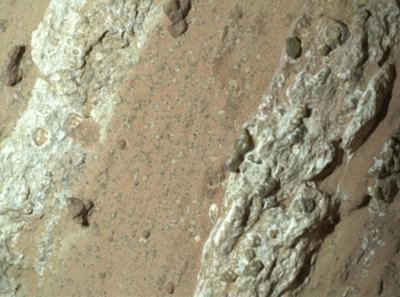
NASA announced on September 10 that its Perseverance Mars rover had collected a rock sample from an ancient dry riverbed in Jezero Crater that may contain preserved evidence of ancient microbial life on the planet.

The sample was obtained from a rock named “Cheyava Falls” in 2024, and the sample, named “Sapphire Canyon,” contains potential biosignatures according to a peer-reviewed paper in the journal Nature. The sample was taken while the rover was exploring the “Bright Angel” formation within the Jezero Crater.

In the search for life on Mars or the Moon, a “potential biosignature” is a substance or structure that may have a biological origin but more extensive study and data are needed before any conclusion can be determined about the absence or presence of life.

Sean P. Duffy, acting NASA Administrator said, “This finding by Perseverance, launched under President Trump in his first term, is the closest we have ever come to discovering life on Mars. The identification of a potential biosignature on the Red Planet is a groundbreaking discovery, and one that will advance our understanding of Mars. NASA’s commitment to conducting Gold Standard Science will continue as we pursue our goal of putting American boots on Mars’ rocky soil.”

Nicky Fox, Associate Administrator of the Science Mission Directorate at NASA Headquarters in Washington said, “This finding is the direct result of NASA’s effort to strategically plan, develop, and execute a mission able to deliver exactly this type of science — the identification of a potential biosignature on Mars. With the publication of this peer-reviewed result, NASA makes this data available to the wider science community for further study to confirm or refute its biological potential.”

The science instruments on board the Perseverance Mars rover found that the formation where the sample was taken from contains sedimentary rocks composed of clay and silt, which on Earth are excellent preservers of past life. They also contain rich amounts of organic carbon, sulfur, oxidized iron (rust), and phosphorus.

Joel Hurowitz of Stony Brook University, New York and lead author of the Nature paper, is a scientist working on the Perseverance project.

He said, “The combination of chemical compounds we found in the Bright Angel formation could have been a rich source of energy for microbial metabolisms. But just because we saw all these compelling chemical signatures in the data didn’t mean we had a potential biosignature. We needed to analyze what that data could mean.”

FMI:  science.nasa.gov/ , www.nature.com/

Advertisement

More News

Aero-News: Quote of the Day (12.09.25)

“We respectfully call on the City of Mesa to: 1. Withdraw the landing fee proposal immediately 2. Engage with the aviation community before making decisions that impact safet>[...]

ANN's Daily Aero-Term (12.09.25): High Speed Taxiway

High Speed Taxiway A long radius taxiway designed and provided with lighting or marking to define the path of aircraft, traveling at high speed (up to 60 knots), from the runway ce>[...]

ANN's Daily Aero-Linx (12.09.25)

Aero Linx: International Federation of Airworthiness (IFA) IFA uniquely combines together all those with responsibility for policies, principles and practices concerned with the co>[...]

NTSB Final Report: Diamond Aircraft Ind Inc DA20C1 (A1); Robinson Helicopter R44

Controller’s Expectation That VW02 Would Have Departed Sooner Led To An Inadequate Scan And Loss Of Situational Awareness Analysis: A Robinson R-44 helicopter N744AF, VW02 (V>[...]

ANN FAQ: Q&A 101

A Few Questions AND Answers To Help You Get MORE Out of ANN! 1) I forgot my password. How do I find it? 1) Easy... click here and give us your e-mail address--we'll send it to you >[...]

blog comments powered by Disqus



Advertisement

Advertisement

Podcasts

Advertisement

© 2007 - 2025 Web Development & Design by Pauli Systems, LC

