
Airbus-Built Aeolus Wind Sensor Satellite Ready For Shipment | Aero-News Network
Aero-News Network
RSS icon RSS feed
podcast icon MP3 podcast
Subscribe Aero-News e-mail Newsletter Subscribe

Airborne Unlimited -- Most Recent Daily Episodes

Episode Date

Airborne-Monday

Airborne-Tuesday

Airborne-Wednesday Airborne-Thursday

Airborne-Friday

Airborne On YouTube

Airborne-Unlimited-12.08.25

AirborneNextGen-
12.09.25

Airborne-Unlimited-12.10.25

Airborne-AffordableFlyers-12.11.25

AirborneUnlimited-12.12.25

AFE 2025 LIVE MOSAIC Town Hall (Archived): www.airborne-live.net

Mon, Jun 11, 2018

Airbus-Built Aeolus Wind Sensor Satellite Ready For Shipment

First Ever Satellite Able To Perform Global Wind Component Profile Observation

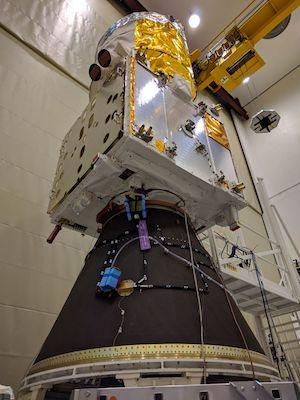
Aeolus, the European Space Agency’s wind sensing satellite, is now ready for its upcoming launch. It will be shipped across the Atlantic on the Airbus vessel “Ciudad de Cádiz" to Kourou, French Guiana, where a Vega launcher will send it to orbit on 21 August. The instrument is so sensitive that it could be damaged by a sudden loss of pressure. For this reason, air transportation has to be avoided and for the first time Airbus will transport one of its satellites on-board its own vessel.

The spacecraft, built by Airbus, features the first ever space-borne LIDAR (LIght Detection And Ranging) instrument called Aladin, which uses the Doppler effect to determine the wind speed at varying altitudes.

Aladin fires a powerful ultraviolet laser pulse down through the atmosphere and collects backscattered light, using a large 1.5m diameter telescope, which is then analysed on-board by highly sensitive receivers to determine the Doppler shift of the signal from layers at different heights in the atmosphere.

“Aeolus is a world first with break-through technology that will make a huge contribution to weather forecasting on a global scale. Pioneering a LIDAR instrument in Space is quite a challenge – but a great example of what Europeans can achieve when we work together," said Nicolas Chamussy, Head of Space Systems at Airbus.

The data from Aeolus will provide reliable wind-profile data on a global scale and is needed by meteorologists to further improve the accuracy of weather forecasts and by climatologists to better understand the global dynamics of Earth’s atmosphere.

Aeolus will orbit the Earth 15 times a day with data delivery to users within 120 minutes of the oldest measurement in each orbit. The orbit repeat cycle is 7 days (every 111 orbits) and the spacecraft will fly in a 200-mile orbit for three years.

(Image provided with Airbus news release)

FMI: www.airbus.com

Advertisement

More News

Aero-News: Quote of the Day (12.09.25)

“We respectfully call on the City of Mesa to: 1. Withdraw the landing fee proposal immediately 2. Engage with the aviation community before making decisions that impact safet>[...]

ANN's Daily Aero-Term (12.09.25): High Speed Taxiway

High Speed Taxiway A long radius taxiway designed and provided with lighting or marking to define the path of aircraft, traveling at high speed (up to 60 knots), from the runway ce>[...]

ANN's Daily Aero-Linx (12.09.25)

Aero Linx: International Federation of Airworthiness (IFA) IFA uniquely combines together all those with responsibility for policies, principles and practices concerned with the co>[...]

NTSB Final Report: Diamond Aircraft Ind Inc DA20C1 (A1); Robinson Helicopter R44

Controller’s Expectation That VW02 Would Have Departed Sooner Led To An Inadequate Scan And Loss Of Situational Awareness Analysis: A Robinson R-44 helicopter N744AF, VW02 (V>[...]

ANN FAQ: Q&A 101

A Few Questions AND Answers To Help You Get MORE Out of ANN! 1) I forgot my password. How do I find it? 1) Easy... click here and give us your e-mail address--we'll send it to you >[...]

blog comments powered by Disqus



Advertisement

Advertisement

Podcasts

Advertisement

© 2007 - 2025 Web Development & Design by Pauli Systems, LC

