
US Army's JLENS Will Protect Sailors, Critical Waterways | Aero-News Network
Aero-News Network
RSS icon RSS feed
podcast icon MP3 podcast
Subscribe Aero-News e-mail Newsletter Subscribe

Airborne Unlimited -- Most Recent Daily Episodes

Episode Date

Airborne-Monday

Airborne-Tuesday

Airborne-Wednesday Airborne-Thursday

Airborne-Friday

Airborne On YouTube

Airborne-Unlimited-12.08.25

AirborneNextGen-
12.09.25

Airborne-Unlimited-12.10.25

Airborne-AffordableFlyers-12.11.25

AirborneUnlimited-12.12.25

AFE 2025 LIVE MOSAIC Town Hall (Archived): www.airborne-live.net

Tue, Sep 11, 2012

US Army's JLENS Will Protect Sailors, Critical Waterways

JLENS Proves Capable Of Tracking Swarming Boats

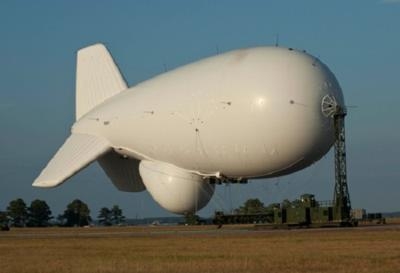
Soldiers will soon have a system that enables them to protect sailors and safeguard commercial and military navigation in strategic waterways. In June, a series of tests demonstrated that Raytheon's JLENS (Joint Land Attack Cruise Missile Defense Elevated Netted Sensor System) is capable of detecting and tracking swarming boats from hundreds of miles away. During the tests, JLENS simultaneously detected and tracked multiple speedboats on the Great Salt Lake in Utah. The boats, similar to swarming boats in the inventories of hostile navies in high-threat regions, simulated a real-world scenario with a series of tactical maneuvers at low and high speeds.

"JLENS is affordable because during a 30-day period, one system provides the warfighter the same around-the-clock coverage that it would normally take four or five fixed-wing surveillance aircraft to provide," said David Gulla, vice president of Global Integrated Sensors for Raytheon's Integrated Defense Systems business. "JLENS is significantly less expensive to operate than a fixed-wing surveillance aircraft because it takes less than half the manpower to operate and has a negligible maintenance and fuel cost."

JLENS is an elevated, persistent over-the-horizon sensor system. It uses a powerful integrated radar system to detect, track and target a variety of threats. This capability better enables commanders to defend against threats, including hostile cruise missiles, low-flying manned and unmanned aircraft, and moving surface vehicles such as boats, SCUD-launchers, automobiles, trucks and tanks -- and provides ascent phase detection of tactical ballistic missiles and large caliber rockets.

(Image provided by Raytheon)

FMI: www.army.mil

Advertisement

More News

Aero-News: Quote of the Day (12.09.25)

“We respectfully call on the City of Mesa to: 1. Withdraw the landing fee proposal immediately 2. Engage with the aviation community before making decisions that impact safet>[...]

ANN's Daily Aero-Term (12.09.25): High Speed Taxiway

High Speed Taxiway A long radius taxiway designed and provided with lighting or marking to define the path of aircraft, traveling at high speed (up to 60 knots), from the runway ce>[...]

ANN's Daily Aero-Linx (12.09.25)

Aero Linx: International Federation of Airworthiness (IFA) IFA uniquely combines together all those with responsibility for policies, principles and practices concerned with the co>[...]

NTSB Final Report: Diamond Aircraft Ind Inc DA20C1 (A1); Robinson Helicopter R44

Controller’s Expectation That VW02 Would Have Departed Sooner Led To An Inadequate Scan And Loss Of Situational Awareness Analysis: A Robinson R-44 helicopter N744AF, VW02 (V>[...]

ANN FAQ: Q&A 101

A Few Questions AND Answers To Help You Get MORE Out of ANN! 1) I forgot my password. How do I find it? 1) Easy... click here and give us your e-mail address--we'll send it to you >[...]

blog comments powered by Disqus



Advertisement

Advertisement

Podcasts

Advertisement

© 2007 - 2025 Web Development & Design by Pauli Systems, LC

