
Pratt & Whitney Rocketdyne Successfully Tests Orion Propulsion Technology | Aero-News Network
Aero-News Network
RSS icon RSS feed
podcast icon MP3 podcast
Subscribe Aero-News e-mail Newsletter Subscribe

Airborne Unlimited -- Most Recent Daily Episodes

Episode Date

Airborne-Monday

Airborne-Tuesday

Airborne-Wednesday Airborne-Thursday

Airborne-Friday

Airborne On YouTube

Airborne-Unlimited-12.01.25

AirborneNextGen-
12.02.25

Airborne-Unlimited-12.03.25

Airborne-FltTraining-12.04.25

AirborneUnlimited-12.05.25

AFE 2025 LIVE MOSAIC Town Hall (Archived): www.airborne-live.net

Tue, Apr 07, 2009

Pratt & Whitney Rocketdyne Successfully Tests Orion Propulsion Technology

Methane/Oxygen Motors Will Send Humans To Moon, Mars and Beyond

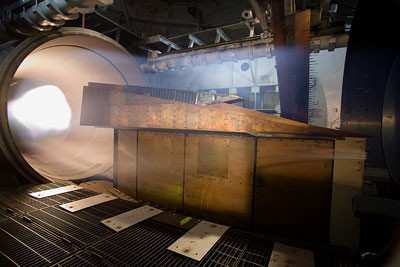
Pratt & Whitney Rocketdyne completed a series of successful hot-fire tests for a propulsion system that could lead to increased mission capability and flexibility in sending humans to the moon, Mars and beyond.

During the tests at NASA's Glenn Research Center in Cleveland, OH a 25 pound-force thruster testbed successfully demonstrated cooling with gaseous methane and gaseous oxygen, as well as rapid start and stop at simulated altitude conditions. The tests also gathered a wide range of data on ignition and combustion performance. A test program highlight was the igniter demonstration of split-second pulses that emulate how a spacecraft may perform during a mission.

"These successful tests mark another milestone for Pratt & Whitney Rocketdyne's contribution to the US Space Exploration Policy," said Terry Lorier, program manager, Space Propulsion Systems Development, Pratt & Whitney Rocketdyne. "It demonstrates our team is ready to proceed with development of this technology, and provides data in support of NASA's upcoming decision on whether to baseline oxygen and methane as propellants for use on future NASA vehicles and missions."

The hot-fire testing was conducted as part of the Propulsion and Cryogenics Advanced Development (PCAD) project under NASA's Exploration Technology Development Program (ETDP). The goal is to develop and demonstrate key technologies that will enable NASA to conduct future human exploration missions to the moon, Mars, and beyond. Testing was conducted at NASA Glenn Research Center under contract management from NASA Johnson Space Center.

FMI: www.pratt-whitney.com

Advertisement

More News

ANN's Daily Aero-Term (12.04.25): Cooperative Surveillance

Cooperative Surveillance Any surveillance system, such as secondary surveillance radar (SSR), wide-area multilateration (WAM), or ADS-B, that is dependent upon the presence of cert>[...]

ANN's Daily Aero-Linx (12.04.25)

Aero Linx: OX5 Aviation Pioneers Incorporated in 1955 as a Pa 501 (c)(3) Not for Profit Corporation, the OX5 Aviation Pioneers is dedicated to bringing before the public the accomp>[...]

NTSB Prelim: Extra Flugzeugproduktions EA 300/SC

The Pilot Appeared To Regain Control After Six Rotations And Attempted To “Fly Out” Inverted But Had Insufficient Altitude On November 8, 2025, at 1038 eastern standard>[...]

Classic Aero-TV: The Bally Bomber - The All Time Ultimate Warbird Replica?

From 2018 (YouTube Edition): Aero-News Talks With The Airplane's Builder One of the many unique airplanes at AirVenture 2018 was a 1/3-scale B-17 bomber built by Jack Bally, who ta>[...]

ANN's Daily Aero-Linx (12.05.25)

Aero Linx: Society of U.S. Army Flight Surgeons (SoUSAFS) The Society of US Army Flight Surgeons (SoUSAFS) serves to advance the science and art of Aerospace Medicine and its allie>[...]

blog comments powered by Disqus



Advertisement

Advertisement

Podcasts

Advertisement

© 2007 - 2025 Web Development & Design by Pauli Systems, LC

