Tue, Oct 21, 2008
Cites Failure To Deploy Raft As Causal To December 2007
Fatality
 The National Transportation Safety
Board issued two new recommendations Monday, aimed at improving
passenger awareness of how to properly deploy the emergency life
rafts commonly seen on the exteriors of turbine-powered helicopters
operating offshore.
The National Transportation Safety
Board issued two new recommendations Monday, aimed at improving
passenger awareness of how to properly deploy the emergency life
rafts commonly seen on the exteriors of turbine-powered helicopters
operating offshore.
The Board cites the December 29, 2007 downing of an Air
Logistics Bell 206L1 helicopter. The helicopter impacted water
while approaching South Pass Block 38 (SP38), an offshore platform
in the Gulf of Mexico, with a commercial pilot and three passengers
aboard.
All four occupants survived the crash, but one passenger died
while awaiting rescue... a condition the NTSB attributes to the
pilot's failure to properly instruct the passengers on how to
deploy the life raft.
"During a postaccident interview, the accident pilot provided no
indication why he did not deploy the external life raft using the
internal T-handle when the helicopter entered the water, even
though he had received training on external liferaft deployments,"
the Board writes. "The pilot stated that, after evacuating the
helicopter, he climbed onto its belly and asked the passengers to
pull the 'red handle' (that is, one of the external T-handles) for
the life raft but that the passengers could not locate either
T-handle.
"One of the surviving passengers stated that he thought the
pilot was referring to the red inflation tabs on their PFDs. Both
surviving passengers stated that they did not know that the
helicopter was equipped with external life raft with external
activation handles," the NTSB adds.
The NTSB has recommended that the FAA:
- Require operators of turbine-powered helicopters with
externally mounted life raft to install a placard for each external
T-handle that clearly identifies the location of and provides
activation instructions for the handle. (A-08-83)
- Require all operators of turbine-powered helicopters to
include, in pilot preflight safety briefings to passengers before
each takeoff, information about the location and activation of all
flotation equipment, including internal or external life raft
(depending on which system has been installed on the helicopter).
(A-08-84)
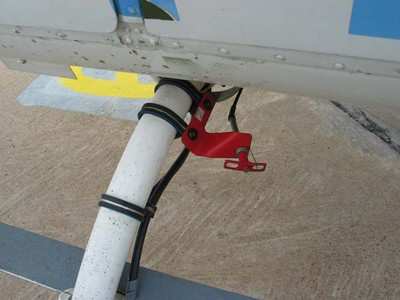
"The Safety Board concludes that external placards for the two
external liferaft T-handles, similar to the placard for the
T-handle in the cockpit, would assist passengers in finding and
activating the external T-handles, especially if the pilot were
unable to do so," the NTSB concludes. "Therefore, the Safety Board
believes that the FAA should require operators of turbine-powered
helicopters with externally mounted life raft to install a placard
for each external T-handle that clearly identifies the location of
and provides activation instructions for the handle."
More News
“These new aircraft strengthen our ability to respond quickly, train effectively and support communities nationwide. Textron Aviation has been a steadfast supporter in helpin>[...]
From 2011 (YouTube Edition): Rugged, Legendary, STOL Twin Makes A Comeback The de Havilland Twin Otter is an airplane with a long history, and it gained a reputation as a workhorse>[...]
A Wind Gust Lifted The Right Wing And The Airplane Turned To The Left Analysis: The pilot was departing from a 2,395-ft-long by 50-ft-wide turf runway. The pilot reported that afte>[...]
Have A Story That NEEDS To Be Featured On Aero-News? Here’s How To Submit A Story To Our Team Some of the greatest new stories ANN has ever covered have been submitted by our>[...]
Braking Action Advisories When tower controllers receive runway braking action reports which include the terms “medium," “poor," or “nil," or whenever weather con>[...]



 Aero-News: Quote of the Day (12.18.25)


 See All