
USAF Says 'Distorted Data' To Blame For Guam B-2 Accident | Aero-News Network
Aero-News Network
RSS icon RSS feed
podcast icon MP3 podcast
Subscribe Aero-News e-mail Newsletter Subscribe

Airborne Unlimited -- Most Recent Daily Episodes

Episode Date

Airborne-Monday

Airborne-Tuesday

Airborne-Wednesday Airborne-Thursday

Airborne-Friday

Airborne On YouTube

Airborne-Unlimited-12.01.25

AirborneNextGen-
12.02.25

Airborne-Unlimited-12.03.25

Airborne-FltTraining-12.04.25

AirborneUnlimited-12.05.25

AFE 2025 LIVE MOSAIC Town Hall (Archived): www.airborne-live.net

Fri, Jun 06, 2008

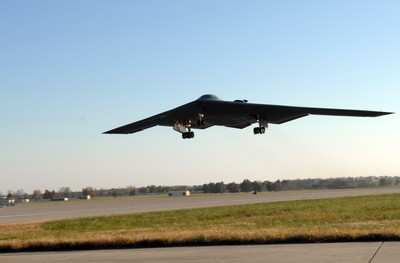
USAF Says 'Distorted Data' To Blame For Guam B-2 Accident

Moisture In Transducers Led To Flight Control Errors

The US Air Force says distorted data introduced by a B-2 Spirit's air data system skewed information entering the bomber's flight control computers, ultimately causing the crash of the aircraft on takeoff at Andersen Air Force Base, Guam, February 23. That's the conclusion reached in an Air Combat Command accident investigation report released Thursday.

Moisture in the aircraft's Port Transducer Units during air data calibration distorted the information in the bomber's air data system, causing the flight control computers to calculate an inaccurate airspeed and a negative angle of attack upon takeoff.

According to the report, this caused an, "uncommanded 30 degree nose-high pitch-up on takeoff, causing the aircraft to stall and its subsequent crash."

Earlier reports stating a fire onboard may have contributed to the crash were apparently erroneous. Instead, the USAF says, moisture in the PTUs, inaccurate airspeed, a negative AOA calculation and low altitude/low airspeed were substantially contributing factors in the mishap.

Another substantially contributing factor was the ineffective communication of critical information regarding a suggested technique of turning on pitot heat in order to remove moisture from the PTUs prior to performing an air data calibration.

The pilot received minor injuries, and the co-pilot received a spinal compression fracture during ejection. He was treated at Tripler Army Medical Center, Hawaii, and released. The aircraft was assigned to the 509th Bomb Wing at Whiteman Air Force Base, MO.

The cost of the lost aircraft is about $1.4 billion.

FMI: www.langley.af.mil

Advertisement

More News

ANN's Daily Aero-Term (12.04.25): Cooperative Surveillance

Cooperative Surveillance Any surveillance system, such as secondary surveillance radar (SSR), wide-area multilateration (WAM), or ADS-B, that is dependent upon the presence of cert>[...]

ANN's Daily Aero-Linx (12.04.25)

Aero Linx: OX5 Aviation Pioneers Incorporated in 1955 as a Pa 501 (c)(3) Not for Profit Corporation, the OX5 Aviation Pioneers is dedicated to bringing before the public the accomp>[...]

NTSB Prelim: Extra Flugzeugproduktions EA 300/SC

The Pilot Appeared To Regain Control After Six Rotations And Attempted To “Fly Out” Inverted But Had Insufficient Altitude On November 8, 2025, at 1038 eastern standard>[...]

Classic Aero-TV: The Bally Bomber - The All Time Ultimate Warbird Replica?

From 2018 (YouTube Edition): Aero-News Talks With The Airplane's Builder One of the many unique airplanes at AirVenture 2018 was a 1/3-scale B-17 bomber built by Jack Bally, who ta>[...]

ANN's Daily Aero-Linx (12.05.25)

Aero Linx: Society of U.S. Army Flight Surgeons (SoUSAFS) The Society of US Army Flight Surgeons (SoUSAFS) serves to advance the science and art of Aerospace Medicine and its allie>[...]

blog comments powered by Disqus



Advertisement

Advertisement

Podcasts

Advertisement

© 2007 - 2025 Web Development & Design by Pauli Systems, LC

