
USAF Says 'Distorted Data' To Blame For Guam B-2 Accident | Aero-News Network
Aero-News Network
RSS icon RSS feed
podcast icon MP3 podcast
Subscribe Aero-News e-mail Newsletter Subscribe

Airborne Unlimited -- Most Recent Daily Episodes

Episode Date

Airborne-Monday

Airborne-Tuesday

Airborne-Wednesday Airborne-Thursday

Airborne-Friday

Airborne On YouTube

Airborne-Unlimited-12.01.25

AirborneNextGen-
12.02.25

Airborne-Unlimited-12.03.25

Airborne-FltTraining-12.04.25

AirborneUnlimited-12.05.25

AFE 2025 LIVE MOSAIC Town Hall (Archived): www.airborne-live.net

Fri, Jun 06, 2008

USAF Says 'Distorted Data' To Blame For Guam B-2 Accident

Moisture In Transducers Led To Flight Control Errors

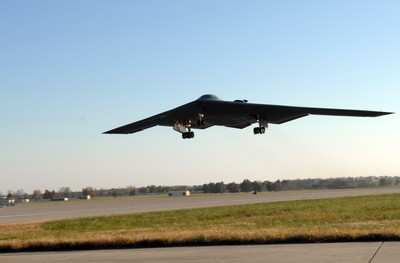
The US Air Force says distorted data introduced by a B-2 Spirit's air data system skewed information entering the bomber's flight control computers, ultimately causing the crash of the aircraft on takeoff at Andersen Air Force Base, Guam, February 23. That's the conclusion reached in an Air Combat Command accident investigation report released Thursday.

Moisture in the aircraft's Port Transducer Units during air data calibration distorted the information in the bomber's air data system, causing the flight control computers to calculate an inaccurate airspeed and a negative angle of attack upon takeoff.

According to the report, this caused an, "uncommanded 30 degree nose-high pitch-up on takeoff, causing the aircraft to stall and its subsequent crash."

Earlier reports stating a fire onboard may have contributed to the crash were apparently erroneous. Instead, the USAF says, moisture in the PTUs, inaccurate airspeed, a negative AOA calculation and low altitude/low airspeed were substantially contributing factors in the mishap.

Another substantially contributing factor was the ineffective communication of critical information regarding a suggested technique of turning on pitot heat in order to remove moisture from the PTUs prior to performing an air data calibration.

The pilot received minor injuries, and the co-pilot received a spinal compression fracture during ejection. He was treated at Tripler Army Medical Center, Hawaii, and released. The aircraft was assigned to the 509th Bomb Wing at Whiteman Air Force Base, MO.

The cost of the lost aircraft is about $1.4 billion.

FMI: www.langley.af.mil

Advertisement

More News

Classic Aero-TV: VerdeGo Debuts VH-3 Hybrid-Electric Powerplant

From 2023 (YouTube Edition): New Propulsion Scheme Optimized for AAM Applications Founded in 2017 by Eric Bartsch, Pat Anderson, and Erik Lindbergh (grandson of famed aviation pion>[...]

NTSB Prelim: Grumman American Avn. Corp. AA-5B

During The Initial Climb, The Engine Began To Operate Abnormally And, After About Three Seconds, Experienced A Total Loss Of Power On October 29, 2025, about 1820 Pacific daylight >[...]

ANN's Daily Aero-Linx (12.02.25)

Aero Linx: Women in Aviation International Women in Aviation International is the largest nonprofit organization that envisions a world where the sky is open to all, and where avia>[...]

Aero-News: Quote of the Day (12.02.25)

“We’ve paid for the cable line’s repair for the customer and have apologized for the inconvenience this caused them...” Source: Some followup info from an A>[...]

Aero-News: Quote of the Day (12.03.25)

“We have long warned about the devastating effects of pairing optimization. Multiple times over many months, we highlighted how schedule manipulation, unbalanced schedules, a>[...]

blog comments powered by Disqus



Advertisement

Advertisement

Podcasts

Advertisement

© 2007 - 2025 Web Development & Design by Pauli Systems, LC

