
NASA Mars Lander Scoops First Soil Sample For Lab Analysis | Aero-News Network
Aero-News Network
RSS icon RSS feed
podcast icon MP3 podcast
Subscribe Aero-News e-mail Newsletter Subscribe

Airborne Unlimited -- Most Recent Daily Episodes

Episode Date

Airborne-Monday

Airborne-Tuesday

Airborne-Wednesday Airborne-Thursday

Airborne-Friday

Airborne On YouTube

Airborne-Unlimited-12.01.25

AirborneNextGen-
12.02.25

Airborne-Unlimited-12.03.25

Airborne-FltTraining-12.04.25

AirborneUnlimited-12.05.25

AFE 2025 LIVE MOSAIC Town Hall (Archived): www.airborne-live.net

Sat, Jun 07, 2008

NASA Mars Lander Scoops First Soil Sample For Lab Analysis

Thermal Analyzer Will Study Sample For Signs Of Water

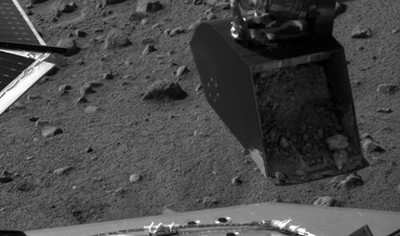
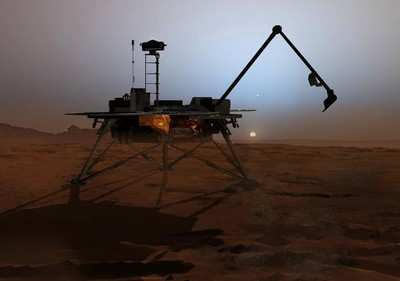
Looking a bit like the world's most awesome Tonka toy (below), NASA's Phoenix Mars Lander made its first dig into Martian soil for science studies and is poised to deliver the scoopful to a laboratory instrument on the lander deck. The instrument will bake and sniff the soil to assess its volatile ingredients, such as water.

Commands were received by Phoenix Friday, for the spacecraft's Robotic Arm to dump the sample into an opened door on the instrument called the Thermal and Evolved-Gas Analyzer, or TEGA.

"It's looks like a good sample for us," said Peter Smith, Phoenix principal investigator at the University of Arizona, Tucson. "Over the next few days, and it may be as much as a week, the TEGA instrument will be analyzing this sample."

Phoenix's Robotic Arm collected the sample of clumpy, reddish material from the top 2 to 4 centimeters (0.8 to 1.6 inches) of surface material at a site informally named "Baby Bear" on the north side of the lander. In the past week, engineers had used the arm to collect two practice scoops adjacent to Baby Bear and dump those scoopfuls back onto the surface. They have prepared for years with simulations and versions of the arm on Earth.

"It's like being on a football team and having a pre-season that lasted five years, and now we're finally playing first game," said Matt Robinson, of NASA's Jet Propulsion Laboratory, Pasadena, CA. He is the robotic arm flight software lead for the Phoenix team.

The move was calculated to get enough material to be sure to get some delivered into the instrument without inundating the instrument with unnecessary extra soil. "We're ecstatic that we got a quarter to a third of a scoopful," Robinson said.

The TEGA instrument will begin analyzing the sample for water and mineral content after it has analyzed a sample of the Martian atmosphere. Water can be bound to minerals, such as clays or carbonates, and it takes more heat to drive the water off some minerals than others. This is how the instrument can identify some minerals in the soil.

"We are particularly interested in minerals that are formed or altered by the action of liquid water in the soil," Smith said.

FMI: http://www.nasa.gov/phoenix, http://phoenix.lpl.arizona.edu

Advertisement

More News

ANN's Daily Aero-Term (12.04.25): Cooperative Surveillance

Cooperative Surveillance Any surveillance system, such as secondary surveillance radar (SSR), wide-area multilateration (WAM), or ADS-B, that is dependent upon the presence of cert>[...]

ANN's Daily Aero-Linx (12.04.25)

Aero Linx: OX5 Aviation Pioneers Incorporated in 1955 as a Pa 501 (c)(3) Not for Profit Corporation, the OX5 Aviation Pioneers is dedicated to bringing before the public the accomp>[...]

NTSB Prelim: Extra Flugzeugproduktions EA 300/SC

The Pilot Appeared To Regain Control After Six Rotations And Attempted To “Fly Out” Inverted But Had Insufficient Altitude On November 8, 2025, at 1038 eastern standard>[...]

Classic Aero-TV: The Bally Bomber - The All Time Ultimate Warbird Replica?

From 2018 (YouTube Edition): Aero-News Talks With The Airplane's Builder One of the many unique airplanes at AirVenture 2018 was a 1/3-scale B-17 bomber built by Jack Bally, who ta>[...]

ANN's Daily Aero-Linx (12.05.25)

Aero Linx: Society of U.S. Army Flight Surgeons (SoUSAFS) The Society of US Army Flight Surgeons (SoUSAFS) serves to advance the science and art of Aerospace Medicine and its allie>[...]

blog comments powered by Disqus



Advertisement

Advertisement

Podcasts

Advertisement

© 2007 - 2025 Web Development & Design by Pauli Systems, LC

