NASA's Space Eyes Focus on Deep Impact Target
On July 4, NASA's Deep Impact spacecraft will
attempt an extraordinarily daring encounter with the far-flung
comet Tempel 1, which is hurtling through space at tens of
thousands of miles per hour. As if that is not challenging enough,
the comet's size, shape and other characteristics are not entirely
known.

Two of NASA's eyes in the sky, the Spitzer and Hubble Space
Telescopes, helped scientists prepare for the comet encounter. From
their orbits high above Earth, the telescopes watched Tempel 1 in
early 2004. Together they came up with the best estimates of the
comet's size, shape, reflectivity and rotation rate. The data may
help Deep Impact snap pictures of the dramatic rendezvous and
increase the probability of making contact with the comet.
"Even tiny adjustments to our model of Tempel 1 are crucial to
hitting the target and setting camera exposure times," said Dr.
Carey Lisse, Johns Hopkins University Applied Physics Laboratory,
Laurel, Md. Lisse is team leader for the Tempel 1 Spitzer
studies.
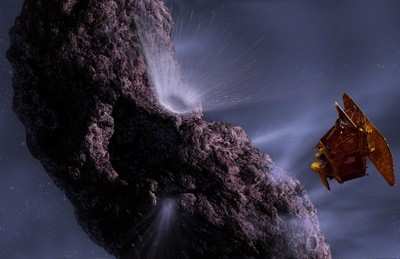
Previous observations of Tempel 1 taken with ground-based
telescopes indicated the comet is dark and oblong, with a width of
a few miles, or kilometers. Spitzer and Hubble refined these
measurements, revealing a matte black comet approximately 14 by 4
kilometers (8.7 by 2.5 miles), or roughly one-half the size of
Manhattan.
"Spitzer was crucial in pinning down the comet's size," said Dr.
Michael A'Hearn of the University of Maryland, College Park. He is
principal investigator for Deep Impact and the Hubble observations.
"We'll know exactly what it looks like when we get there."
The Deep Impact spacecraft was launched on Jan. 12, 2005. Its
mission is to study the primordial soup of our solar system, which
is sealed away inside comets.
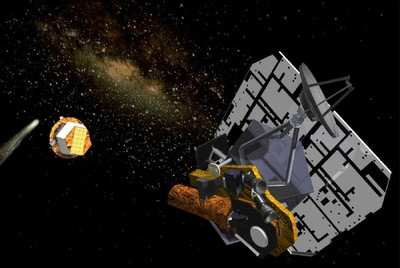
On July 3, as it approaches Tempel 1, the spacecraft will
separate into two parts. The impactor will attempt the tricky task
of placing itself in the path of the speeding snowball, while the
second part, the flyby spacecraft, swings around for a ringside
view.
After the impactor is released, its specialized software will
steer it toward the sunlit portion of Tempel 1's nucleus. To
program the software, mission planners at NASA's Jet Propulsion
Laboratory, Pasadena, Calif., needed to know the size and
reflectivity of Tempel 1's surface. Since its surface can't be
observed directly from Earth, scientists turned to Spitzer's
infrared eyes to measure its size.
When viewing a comet in visible light from very far away, only
reflected sunlight can be seen, so a big, dark comet can look the
same as a highly reflective, small comet. In infrared light, a
comet's radiated heat is measured, providing a direct look at its
size.
Once the size of Tempel 1 was known, scientists could calculate
surface reflectivity using a combination of Spitzer and Hubble
data. They found Tempel 1 reflects only four percent of the
sunlight that falls on it.
"Knowing the reflectivity also tells us how to set up our
cameras," Lisse said. "Like photographers, it's important for us to
know our subject before the shoot."
Tempel 1's shape and two-day rotation rate were derived from
long-term observations made by various telescopes, including
Hubble, Spitzer and the University of Hawaii's 2.2-meter telescope
at Mauna Kea.
In addition to the flyby spacecraft, at least 30 telescopes
around the world, including Spitzer, Hubble and the Chandra X-ray
Observatory, will be watching the dramatic impact. By analyzing the
material blown out of the interior of the comet, this global
network of telescopes will assemble a list of the raw ingredients
that went into making the planets in our solar system.



 ANN's Daily Aero-Term (12.04.25): Cooperative Surveillance


 See All