

FAA, Insitu To Study UAS Integration Into NAS | Aero-News Network
Aero-News Network
RSS icon RSS feed
podcast icon MP3 podcast
Subscribe Aero-News e-mail Newsletter Subscribe

Airborne Unlimited -- Most Recent Daily Episodes

Episode Date

Airborne-Monday

Airborne-Tuesday

Airborne-Wednesday Airborne-Thursday

Airborne-Friday

Airborne On YouTube

Airborne-Unlimited-12.08.25

AirborneNextGen-
12.09.25

Airborne-Unlimited-12.10.25

Airborne-AffordableFlyers-12.11.25

AirborneUnlimited-12.05.25

AFE 2025 LIVE MOSAIC Town Hall (Archived): www.airborne-live.net

Fri, Jun 11, 2010

FAA, Insitu To Study UAS Integration Into NAS

Research Managed By Hughes Technical Center In Atlantic City

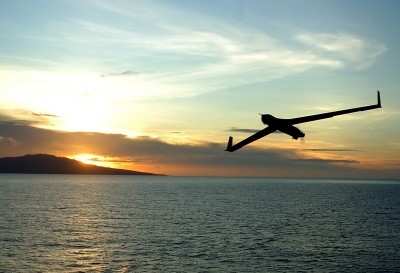
The FAA has signed a cooperative research development agreement (CRDA) with UAS manufacturer Insitu for a ScanEagle unmanned aircraft system (UAS) and related support hardware and data. The FAA will use the aircraft to conduct research needed to guide the development of recommendations for integrating unmanned aircraft systems into the national airspace.

The research will be managed by the Research and Technology Development Office and conducted at the William J. Hughes Technical Center in Atlantic City, NJ. As part of the agreement, Insitu will train FAA pilots and support staff to fly and maintain the system. The company will also supply documentation related to the ScanEagle UAS.

“The FAA has a well-equipped laboratory and resources at the technical center that will allow them to fully evaluate our Tier II system,” said Insitu Vice President, Commercial Business Development Paul McDuffee. “Through the CRDA, the FAA will have an opportunity to better understand UAS design, construction and functionality. It will also begin determining differences in how an air traffic controller manages an unmanned aircraft versus a manned aircraft by integrating the ScanEagle system with existing FAA air traffic control simulation capabilities.”

 
ScanEagle UAS File Photo

Insitu, based in Bingen, WA, is a subsidiary of Boeing.

ScanEagle has proven itself in military operations particularly in providing intelligence, surveillance and reconnaissance and has flown more than 320,000 hours performing such missions. However, the ScanEagle can have practical benefits in civil applications as well. For example, ScanEagle, with its 24-hour endurance capability, can be useful in search and rescue operations, for fire and flood monitoring and for guiding evacuation efforts during hazardous weather conditions, particularly when flying a manned aircraft would be too risky for the pilot or too expensive.

FMI: www.faa.gov, www.insitu.com

Advertisement

More News

ANN's Daily Aero-Term (12.08.25): Decision Altitude (DA)

Decision Altitude (DA) A specified altitude (mean sea level (MSL)) on an instrument approach procedure (ILS, GLS, vertically guided RNAV) at which the pilot must decide whether to >[...]

ANN's Daily Aero-Linx (12.08.25)

Aero Linx: T-34 Association, Inc. The T-34 Association was formed in July 1975 so that individuals purchasing then military surplus T-34As had an organization which would provide s>[...]

NTSB Final Report: Piper PA-31T3

As He Released The Brakes To Begin Taxiing, The Brake Pedals Went To The Floor With No Braking Action Analysis: The pilot reported that during engine start up, he applied the brake>[...]

Aero-News: Quote of the Day (12.08.25)

“Legislation like the Mental Health in Aviation Act is still imperative to hold the FAA accountable for the changes they clearly acknowledge need to be made... We cannot wait>[...]

Airborne-Flight Training 12.04.25: Ldg Fee Danger, Av Mental Health, PC-7 MKX

Also: IAE Acquires Diamond Trainers, Army Drones, FedEx Pilots Warning, DA62 MPP To Dresden Tech Uni The danger to the flight training industry and our future pilots is clear. Dona>[...]

blog comments powered by Disqus



Advertisement

Advertisement

Podcasts

Advertisement

© 2007 - 2025 Web Development & Design by Pauli Systems, LC

