Witness Said Engine 'Didn't Sound Right' Before Rotor Sound Was Lost
The NTSB has released a preliminary report from an accident that occurred April 4 involving a Bell 206L on a sightseeing flight in the Great Smoky Mountains in Pigeon Forge, TN.
According to the report, at about 1610 eastern daylight time the helicopter was destroyed when it impacted terrain after an apparent engine problem. The helicopter was operated by Great Smoky Mountain Helicopters, Inc., doing business as, Smoky Mountain Helicopters.
The commercial pilot and four passengers were fatally injured. Visual meteorological conditions prevailed and no flight plan had been filed for the flight that departed Sixty Six Heliport (6TN3), Sevierville, Tennessee.
According to the operator, the helicopter had been purchased in 1986 for air tour/sight-seeing purposes. At the time of the accident, the operator owned two helicopters, a Bell 206B that was based in Cherokee, NC, and the accident helicopter, which was based at 6TN3.
A company pilot reported that he flew the helicopter an estimated 10 flights on the morning of the accident, and before the accident pilot began flying sometime between 1300 and 1400. The accident pilot performed 4 flights in the helicopter and then shut it down while waiting for additional customers. The accident pilot subsequently restarted the helicopter, and completed a 4 minute flight before departing on the accident flight, which was scheduled to last between 7 and 8 minutes. He further stated that a check of the fuel level prior to departure revealed it was "just below the 6-inch line," which he estimated corresponded to about 300 pounds of fuel on board.
Another helicopter tour company pilot operating in the area about the time of the accident reported that he did not hear any distress calls. He further stated that he recalled the accident pilot made a normal landmark position report over "wonderworks."
A witness who lived near the accident site reported that he was outside when he observed the helicopter flying low in a descent, and it "didn't sound right." He further described the sound as if "the engine was wound tight" and it "lost the rotor sound." He then heard the engine go silent, "as if the pilot cut the power," which was followed by sounds associated with impact. Another witness reported hearing the impact and observed the accident site engulfed in fire.
The helicopter initially impacted trees near the top of a ridge that was about 1,100 feet mean sea level (msl). The helicopter came to rest in a wooded area near the bottom of the ridge, on its left side, on a heading of about 340 degrees magnetic. Two large, freshly broken trees were located about 100 feet south of the main wreckage, which was mostly consumed by a postcrash fire. In addition, the entire area surrounding the main wreckage was charred.
All major structural components of the helicopter were located at the accident site. One of the two main rotor blades was separated, and located about 20 feet northwest of the main wreckage. The leading edges of both main rotor blades did not exhibit significant impact damage. Manual rotation of the main rotor blade that remained attached to the main rotor hub resulted in rotation of the main rotor mast, the engine-to-transmission drive shaft, the engine's No. 4 turbine wheel, the tail rotor drive output, and confirmed free-wheel functionality. The tail rotor drive shaft was fractured in multiple locations. The flexible couplings between the drive shaft flanges were intact and did not display evidence of fractures or deformation consistent with power at impact. The tail rotor gearbox was separated from the tail boom and located about 30 feet southeast of the main wreckage. Manual rotation of the tail rotor blades resulted in rotation of the gearbox input. The splines at the tail rotor gearbox did not
exhibit evidence of fractures or smearing. All three flight control servo control linkages were fractured at multiple locations; however, the linkages remained attached to their respective input and output ends. There was no evidence of damage to the engine's first stage compressor section, or fourth stage turbine wheel.
The engine and airframe were recovered from the accident site and retained for further examination.
Initial review of maintenance records revealed that at the time of the accident, the helicopter had been operated for about 40 hours since its most recent 100 hour and annual inspections, which were performed on March 4, 2016. In addition, the helicopter had been operated for about 22,560 total hours.
The pilot reported 550 hours of total flight experience on his most recent application for a Federal Aviation Administration second-class medical certificate, which was issued on April 21, 2015. According to an initial review of the pilot's logbook, as of March 25, 2016, he had logged about 1,300 hours of total flight experience, which included about 870 hours in Bell 206 series helicopters.
A weather observation taken at airport located about 3 miles northeast of the accident site, about the time of the accident, reported: winds from 220 degrees, at 10 knots, 10 statute miles visibility, clear skies, temperature 24 degrees Celsius (C), dew point 2 degrees C, and an altimeter setting of 29.93 inches of mercury.
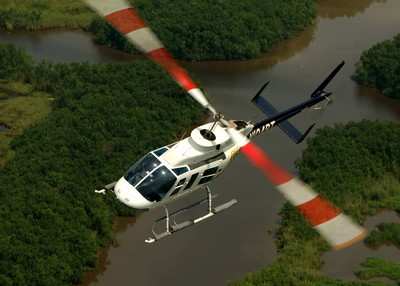
(Image from file. Not accident aircraft)



 ANN's Daily Aero-Term (12.13.25): Light Gun


 See All