John 'Danny' Olivas Addresses Students In NAVAIR Program
From the roof of his childhood home in El Paso, Texas, gazing up at a blanket of stars from a telescope, John “Danny” Olivas could see what felt like forever.
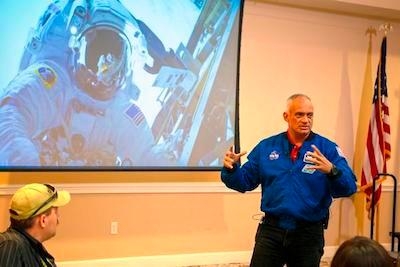
Years later, when he became a NASA astronaut, Olivas would look out at the same stars from the flight deck of the International Space Station.
“Against the backdrop of the universe, and all there is to see and know and do, I felt small but at the same time inspired. All you have to do is look up and be willing to explore,” he said. Olivas spoke as part of NAVAIR’s national Hispanic Heritage Month event Sept. 25 with a theme of “Mission Assurance: Think Like an Astronaut.”
“One of the greatest values I learned at NASA was the value of diverse thought and being inclusive when discussing solutions to problems,” Olivas said. “It wasn’t about one single contribution; it was about everyone working together for something bigger.”
He cited the example of his first spacewalk, during which he helped repair the shuttle while in orbit, when damaged heat shielding posted a potentially disastrous threat to the shuttle and its crew, as an example of diverse teamwork.
“Many of us speak different languages and have different approaches to problem solving,” he said. “Since the year 2000, we have continuously had a human presence in space. Sixteen countries made this happen, all collectively working toward a common goal. It happens because of human interaction and ingenuity. When everyone works together and has a common mission, it shows the kinds of things you can accomplish.”
Part of Olivas’ success stems from taking his own advice to “work hard, and never give up.” Olivas applied to NASA and was rejected annually for close to 10 years before being accepted.
It was his lifelong dream, one that was formed after viewing the stars at age 7 through a “cheap” telescope and, later, visiting the Johnson Space Center in Houston, where he saw pieces of hardware used on the moon.
“It blew my mind,” he recalled. “I remember looking up at this enormous rocket engine and thinking my dad helped make it happen.”
Inspired by his father’s mechanical mindedness, Olivas, too, wanted to tear things apart and put them back together. He pursued a mechanical engineering and materials science doctorate from Rice University and later worked in a jet propulsion laboratory before his stint at NASA.
“If you work hard, you can accomplish anything you want,” Olivas advised. “We’re often the biggest barriers to our success. As soon as we stop telling ourselves reasons we can’t succeed, we can achieve anything. I worked a lifetime to become an astronaut. If you don’t stay focused and work hard, if you just give up, you’ll be defeated.”
This event was co-sponsored by NAVAIR’s Hispanic Engagement Action Team (HEAT) and the Equal Employment Opportunity and Diversity Office. The HEAT was established in 2009 and has partnered with colleges, universities and professional societies to recruit and retain Hispanics. For example, last year, NAVAIR recruiters traveled to the University of Texas, El Paso, where Olivas serves as director of the Center for the Advancement of Space Safety and Mission Assurance, to hire 15 students.
“It’s important because the demographics of the country — and NAVAIR’s talent needs — are changing,” explained Tony Miguelez, a HEAT executive champion. “The only way to get that technical talent is to reach out to places we haven’t been before.”
Currently, Hispanics/Latinos make up close to 7 percent of the NAVAIR civilian workforce and close to 7 percent of the scientists and engineers.
(Image provided with NAVAIR news release)



 ANN's Daily Aero-Term (12.13.25): Light Gun


 See All