
PAL-V And Netherlands Aerospace Achieve Rotor Blade Development | Aero-News Network
Aero-News Network
RSS icon RSS feed
podcast icon MP3 podcast
Subscribe Aero-News e-mail Newsletter Subscribe

Airborne Unlimited -- Most Recent Daily Episodes

Episode Date

Airborne-Monday

Airborne-Tuesday

Airborne-Wednesday Airborne-Thursday

Airborne-Friday

Airborne On YouTube

Airborne-SpecialEpisode-12.15.25

AirborneNextGen-
12.16.25

Airborne-Unlimited-12.10.25

Airborne-AffordableFlyers-12.11.25

AirborneUnlimited-12.12.25

AFE 2025 LIVE MOSAIC Town Hall (Archived): www.airborne-live.net

Sun, Dec 01, 2024

PAL-V And Netherlands Aerospace Achieve Rotor Blade Development

Signals Start Of Production Phase

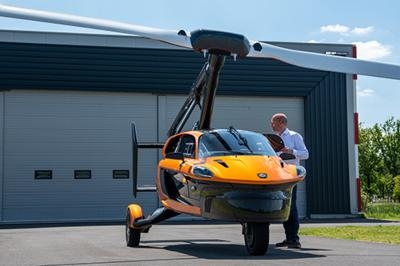
PAL-V and the Netherlands Aerospace Center (NLR) announced the completion of the development phase of the rotor blades for the PAL-V Liberty, a significant step in moving toward the production phase of the flying car.

The collaboration between PAL-V and the NLR, Netherlands’ premier aerospace research institute, took advantage of NRL’s extensive experience in aerospace engineering and composite structures to tackle the development and hone the design of the rotor blades.

The blades are 20 percent more efficient with less drag compared to equivalent blades yielding improved performance and fuel economy. The set of two blades measure about 11 m (36 feet) in length yet weight only 35.8 kg (79 pounds).

With the refined design of the blades completed, PAL-V has created a small-scale assembly facility near its headquarters where the company is getting ready to begin production of the Liberty.

Henri de Vries, Senior Scientist at NLR said, "We are thrilled to have reached another milestone with our new technology for high-end composite rotor blades. Together with PAL-V we’ve overcome technical challenges and ensured our rotor blades are ready for industrial production. Gyroplane rotor blades are brought in motion by the airflow to create lift instead of by using a motor, this is called autorotation.

“So the PAL-V blades are basically its wings during flight. Next to being lightweight, they contain a mid-hinge to fold the blades and enable driving the vehicle on the road with a convenient vehicle length of just 4 meters. This makes its design unique and unprecedented."

FMI:  www.pal-v.com/

Advertisement

More News

ANN's Daily Aero-Term (12.19.25): Ultrahigh Frequency (UHF)

Ultrahigh Frequency (UHF) The frequency band between 300 and 3,000 MHz. The bank of radio frequencies used for military air/ground voice communications. In some instances this may >[...]

NTSB Prelim: Cirrus Design Corp SR22T

During The 7 Second Descent, There Was Another TAWS Alert At Which Time The Engine Remained At Full Power On October 24, 2025 at 2115 mountain daylight time, a Cirrus SR22T, N740TS>[...]

Classic Aero-TV: The Red Tail Project--Carrying the Torch of the Tuskegee Airmen

From 2009 (YouTube Edition): Educational Organization Aims to Inspire by Sharing Tuskegee Story Founding leader Don Hinz summarized the Red Tail Project’s mission in simple, >[...]

Aero-News: Quote of the Day (12.19.25)

“This feels like an important step since space travel for people with disabilities is still in its very early days... I’m so thankful and hope it inspires a change in m>[...]

Airborne 12.17.25: Skydiver Hooks Tail, Cooper Rotax Mount, NTSB v NDAA

Also: New Katanas, Kern County FD Training, IndiGo’s Botched Roster, MGen. Leavitt Named ERAU Dean The Australian Transportation Safety Bureau (ATSB) has wrapped up its inves>[...]

blog comments powered by Disqus



Advertisement

Advertisement

Podcasts

Advertisement

© 2007 - 2025 Web Development & Design by Pauli Systems, LC

