Data Collected By The European Southern Observatory
Astronomers using ALMA and NOEMA have made the first definitive detection of a radioactive molecule in interstellar space. The radioactive part of the molecule is an isotope of aluminium. The observations reveal that the isotope was dispersed into space after the collision of two stars, that left behind a remnant known as CK Vulpeculae. This is the first time that a direct observation has been made of this element from a known source. Previous identifications of this isotope have come from the detection of gamma rays, but their precise origin had been unknown.
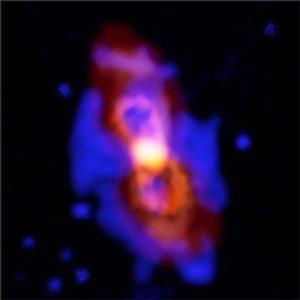
The team, led by Tomasz Kaminski (Harvard-Smithsonian Center for Astrophysics, Cambridge, USA), used the Atacama Large Millimeter/submillimeter Array (ALMA) and the NOrthern Extended Millimeter Array (NOEMA) to detect a source of the radioactive isotope aluminium-26. The source, known as CK Vulpeculae, was first seen in 1670 and at the time it appeared to observers as a bright, red “new star”. Though initially visible with the naked eye, it quickly faded and now requires powerful telescopes to see the remains of this merger, a dim central star surrounded by a halo of glowing material flowing away from it.
348 years after the initial event was observed, the remains of this explosive stellar merger have led to the clear and convincing signature of a radioactive version of aluminum, known as aluminium-26. This is the first unstable radioactive molecule definitively detected outside of the Solar System. Unstable isotopes have an excess of nuclear energy and eventually decay into a stable form.
“This first observation of this isotope in a star-like object is also important in the broader context of galactic chemical evolution,” said Kaminski. “This is the first time an active producer of the radioactive nuclide aluminum-26 has been directly identified.”
Kaminski and his team detected the unique spectral signature of molecules made up of aluminum-26 and fluorine (26AlF) in the debris surrounding CK Vulpeculae, which is about 2000 light-years from Earth. As these molecules spin and tumble through space, they emit a distinctive fingerprint of millimetre-wavelength light, a process known as rotational transition. Astronomers consider this the “gold standard” for detections of molecules.
The observation of this particular isotope provides fresh insights into the merger process that created CK Vulpeculae. It also demonstrates that the deep, dense, inner layers of a star, where heavy elements and radioactive isotopes are forged, can be churned up and cast into space by stellar collisions. “We are observing the guts of a star torn apart three centuries ago by a collision,” remarked Kaminski.
The astronomers also determined that the two stars that merged were of relatively low mass, one being a red giant star with a mass somewhere between 0.8 and 2.5 times that of our Sun. Being radioactive, aluminium-26 will decay to become more stable and in this process one of the protons in the nucleus decays into a neutron. During this process, the excited nucleus emits a photon with very high energy, which we observe as a gamma ray. Previously, detections of gamma ray emission have shown that around two solar masses of aluminium-26 are present across the Milky Way, but the process that created the radioactive atoms was unknown. Furthermore, owing to the way that gamma rays are detected, their precise origin was also largely unknown. With these new measurements, astronomers have definitively detected for the first time an unstable radioisotope in a molecule outside of our Solar System.
At the same time, however, the team have concluded that the production of aluminium-26 by objects similar to CK Vulpeculae is unlikely to be the major source of aluminium-26 in the Milky Way. The mass of aluminium-26 in CK Vulpeculae is roughly a quarter of the mass of Pluto, and given that these events are so rare, it is highly unlikely that they are the sole producers of the isotope in the Milky Way galaxy. This leaves the door open for further studies into these radioactive molecules.
(Image provided with European Southern Observatory news release)



 ANN's Daily Aero-Linx (12.12.25)


 See All