

Another Sign Of The End Of An Era | Aero-News Network
Aero-News Network
RSS icon RSS feed
podcast icon MP3 podcast
Subscribe Aero-News e-mail Newsletter Subscribe

Airborne Unlimited -- Most Recent Daily Episodes

Episode Date

Airborne-Monday

Airborne-Tuesday

Airborne-Wednesday Airborne-Thursday

Airborne-Friday

Airborne On YouTube

Airborne-Unlimited-12.01.25

AirborneNextGen-
12.02.25

Airborne-Unlimited-12.03.25

Airborne-AffordableFlyers-11.20.25

AirborneUnlimited-11.21.25

LIVE MOSAIC Town Hall (Archived): www.airborne-live.net

Sat, Feb 27, 2010

Another Sign Of The End Of An Era

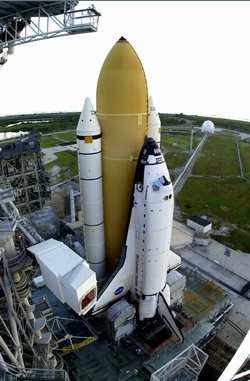
NASA's Space Shuttle Program Successfully Conducts Final Motor Test In Utah

The final tests on a re-usable solid rocket motor for the Space Shuttle program were conduced Thursday at a NASA facility in Pomontory, Utah. The flight support motor, or FSM-17, burned for approximately 123 seconds -- the same time each reusable solid rocket motor burns during an actual space shuttle launch. Preliminary indications show all test objectives were met. After final test data are analyzed, results for each objective will be published in a NASA report.

ATK Launch Systems, a unit of Alliant Techsystems Inc., in Promontory, north of Salt Lake City, manufactures and tests the solid rocket motors.

The test - the 52nd conducted for NASA by ATK - marks the closure of a test program that has spanned more than three decades. The first test was in July 1977. The ATK-built motors have successfully launched the space shuttle into orbit 129 times.

"(Thursday's) test was a great deal more than the successful conclusion to a series of highly successful NASA/ATK-sponsored static tests that began more than three decades ago," said David Beaman, Reusable Solid Rocket Booster project manager at NASA's Marshall Space Flight Center in Huntsville, Ala. The project, part of the Space Shuttle Propulsion Office, is responsible for motor design, development, manufacturing, assembly, testing and flight performance.

"These tests have built a base of engineering knowledge that continued engineering development of the reusable solid rocket motor system and the continued safe and successful launch of space shuttles," Beaman said. "They have provided an engineering model and lessons learned for additional applications in future launch systems."

The final test was conducted to ensure the safe flight of the four remaining space shuttle missions. A total of 43 design objectives were measured through 258 instrument channels during the two-minute static firing. The flight motor tested represents motors that will be used for all remaining space shuttle launches.

The space shuttle's reusable solid rocket motor is the largest solid rocket motor ever flown, the only one rated for human flight and the first designed for reuse. Each shuttle launch requires the boost of two reusable solid rocket motors to lift the 4.5-million-pound shuttle vehicle.

During space shuttle flights, solid rocket motors provide 80 percent of the thrust during the first two minutes of flight. Each motor, the primary component of the shuttle's twin solid rocket boosters, generates an average thrust of 2.6 million pounds and is just over 126 feet long and 12 feet in diameter.

FMI: www.nasa.gov/shuttle

Advertisement

More News

Classic Aero-TV: VerdeGo Debuts VH-3 Hybrid-Electric Powerplant

From 2023 (YouTube Edition): New Propulsion Scheme Optimized for AAM Applications Founded in 2017 by Eric Bartsch, Pat Anderson, and Erik Lindbergh (grandson of famed aviation pion>[...]

NTSB Prelim: Grumman American Avn. Corp. AA-5B

During The Initial Climb, The Engine Began To Operate Abnormally And, After About Three Seconds, Experienced A Total Loss Of Power On October 29, 2025, about 1820 Pacific daylight >[...]

ANN's Daily Aero-Linx (12.02.25)

Aero Linx: Women in Aviation International Women in Aviation International is the largest nonprofit organization that envisions a world where the sky is open to all, and where avia>[...]

Aero-News: Quote of the Day (12.02.25)

“We’ve paid for the cable line’s repair for the customer and have apologized for the inconvenience this caused them...” Source: Some followup info from an A>[...]

Aero-News: Quote of the Day (12.03.25)

“We have long warned about the devastating effects of pairing optimization. Multiple times over many months, we highlighted how schedule manipulation, unbalanced schedules, a>[...]

blog comments powered by Disqus



Advertisement

Advertisement

Podcasts

Advertisement

© 2007 - 2025 Web Development & Design by Pauli Systems, LC

