
SpaceX Falcon9/COTS1 Launch Delayed By Small Cracks | Aero-News Network
Aero-News Network
RSS icon RSS feed
podcast icon MP3 podcast
Subscribe Aero-News e-mail Newsletter Subscribe

Airborne Unlimited -- Most Recent Daily Episodes

Episode Date

Airborne-Monday

Airborne-Tuesday

Airborne-Wednesday Airborne-Thursday

Airborne-Friday

Airborne On YouTube

Airborne-Unlimited-12.01.25

AirborneNextGen-
11.18.25

Airborne-Unlimited-11.19.25

Airborne-AffordableFlyers-11.20.25

AirborneUnlimited-11.21.25

LIVE MOSAIC Town Hall (Archived): www.airborne-live.net

Tue, Dec 07, 2010

SpaceX Falcon9/COTS1 Launch Delayed By Small Cracks

Falcon 9 Launch Attempt Now Scheduled for Wednesday Morning

ANN Update 12.07.2010 2016 EST: NASA announced late Tuesday that the first demonstration flight of SpaceX's Falcon 9 rocket and Dragon capsule for NASA's Commercial Orbital Transportation Services program has been scheduled for Wednesday, Dec. 8, from Cape Canaveral Air Force Station in Florida. The launch window extends from 0900 to 1222 EST.

During a routine inspection this week, SpaceX engineers observed two small cracks in the rocket's second stage engine nozzle. SpaceX completed repairs to the cracked nozzle Tuesday.

Original Story: News and Analysis by Wes Oleszewski

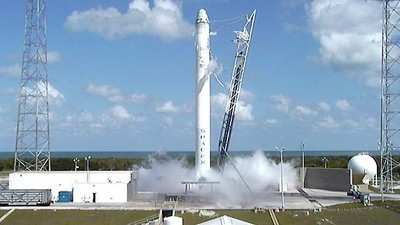
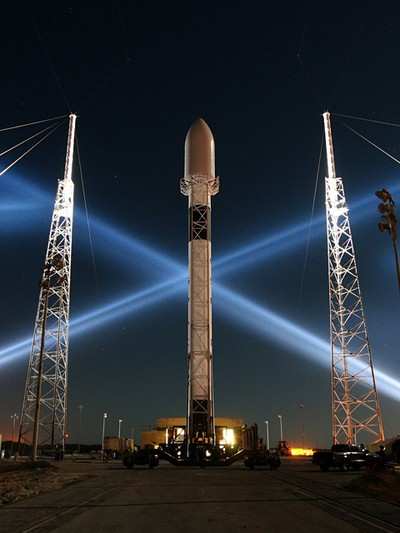
Tuesday's planned launching of SpaceX's second Falcon 9 rocket was scrubbed early Monday. The reason for the scrub was that engineers discovered two small cracks in the aft end of the 2nd stage engine nozzle expansion.

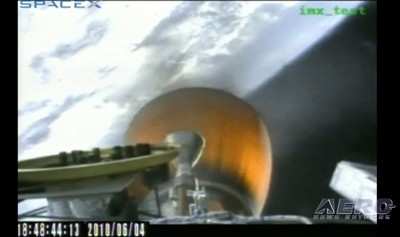
The expansion nozzle on the second stage's Merlin engine is made of a niobium alloy and is used to enhance performance in the vacuum of space. That enhancement was designed to allow the launch vehicle to reach the International Space Station (ISS) or to loft heavy payloads and deep-space vehicles. Since this mission of the Falcon 9 is intended to place the Dragon spacecraft into a simple low earth orbit that is of a far lower incline that that of the ISS, the enhancement value of the nozzle is not required. Speculation, independent of SpaceX, is that if the nozzle extension were to further fracture after stage separation there would be little impact on the overall mission.

Although the nozzle extension is nine feet tall and has a base diameter of eight feet its average wall thickness is less than 1/3 of a millimeter, or slightly thicker than the wall of a soda pop can. Technicians will be able to use small grinding and cutting tools to cut away and smooth the damaged areas. The real question being if the cracks are part of a local anomaly or if they represent a larger problem.

SpaceX, as of this writing, has elected to announce a final launch decision on Tuesday evening after greater study of the issue. If officials are satisfied with the the fixes the Falcon 9 could make a launch attempt as early as Wednesday.

FMI: www.spacex.com


Advertisement

More News

ANN's Daily Aero-Term (11.29.25): Waypoint

Waypoint A predetermined geographical position used for route/instrument approach definition, progress reports, published VFR routes, visual reporting points or points for transiti>[...]

ANN's Daily Aero-Linx (11.29.25)

Aero Linx: Sentimental Journey to Cub Haven Sentimental Journey Flyin began in 1986 with a group of dedicated volunteers working to provide a sentimental return to Lock Haven, the >[...]

NTSB Prelim: Jabiru USA Sport Aircraft LLC J230-SP

The Pilot Would Often Fly Over Their House At A Low Altitude And That Family Members Would Go Outside To Wave On November 14, 2025, at 1708 eastern standard time, a Jabiru USA Spor>[...]

Classic Aero-TV: Crafting The Future of eVTOL Infrastructure

From 2024 (YouTube Edition): Volatus Infrastructure Paves The Way The name “Volatus” seems to be everywhere these days, popping up in a series of partnerships and proje>[...]

Klyde Morris (11.28.25)

Fortnite Conquers All, Klyde FMI: www.klydemorris.com>[...]

blog comments powered by Disqus



Advertisement

Advertisement

Podcasts

Advertisement

© 2007 - 2025 Web Development & Design by Pauli Systems, LC

