Demonstration Project Underway As Alaska Receives First Autolaunch Stations
NOAA’s National Weather Service is tapping technology to automate weather balloon launches in Alaska, a move that will allow staff to improve public service across the state while saving federal tax dollars.
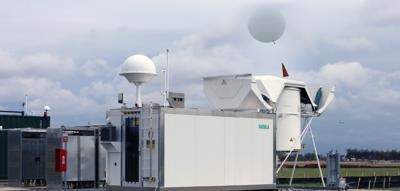
Weather balloons, used by the National Weather Service for the past 80 years, are filled with hydrogen or helium and ascend 22 miles above earth through the troposphere and into the stratosphere. Radio transmitters attached to the balloon measure wind speed and direction, air pressure and temperature and relative humidity, and send this information to ground stations for use by weather models and meteorologists to produce forecasts. Balloons are released twice a day at 92 upper-air sites across the United States.
After nearly two years of field testing the technology in Kodiak, NWS has initiated a demonstration of autolaunchers in Alaska, with two of the state’s 13 upper-air sites already using them. Annette, Alaska, will receive an autolaunch system this month, and the technology will be installed across the state’s remaining 10 sites over the next two years.
The Alaska autolaunch demonstration is part of a broader agency initiative to move the signal used to transmit weather balloon data out of the radio frequency now used by NOAA’s new GOES satellites. Proceeds from the sale of government radio spectrum are funding new ground station equipment at all 92 weather balloon sites across the U.S., and autolaunchers at roughly 25 percent of them, to ready the upper-air program for the frequency migration. NWS is evaluating potential locations outside Alaska to receive the remaining autolaunch systems.
“Alaska is ideal for demonstrating the use of autolaunch technology, especially in the remote areas where it’s tough to recruit and retain staff to perform manual launches,” said Louis W. Uccellini, Ph.D., director of NOAA’s National Weather Service. “We’ll reinvest this time savings back into Alaskan communities with more important weather forecasting and decision support duties – no one will lose their job to this automation.”
Harsh conditions and vast distances between upper-air sites make manual launches particularly expensive and time-consuming. Manual launches take up to four hours of staff time each day to prepare and release the balloons, whereas it takes about an hour every 12 days to refill the autolauncher, along with remote performance monitoring and periodic service maintenance. Though new to the National Weather Service, this proven technology has been used with success in some of the harshest and most remote places in the world.
Uccellini added that autolaunchers will allow NOAA to improve science and service delivery to the whole state. Rather than limiting the staff to launching balloons in remote sections of Alaska, employees will retrain and take on new responsibilities to meet increasing mission demands across the state. These include emerging weather support needs in the Arctic and supporting government leaders whose economic and community safety decisions hinge on accurate weather reports and on understanding their impacts.
Autolaunchers in Alaska will bring other unique benefits. Automation ensures that NOAA can achieve all the scheduled launches, some of which are currently skipped due to staffing shortages – compounded by ongoing challenges to recruit and retain employees for some of the most isolated sites. Relocating jobs from these remote locations will help fill vacancies faster and improve employee retention. On balance, NOAA anticipates a $20 million cost savings over the 20-year life of the equipment by switching to autolaunchers in Alaska.
(Image provided with NOAA news release)



 Classic Aero-TV: In Praise of Alabamas Patriot Aircraft USA


 See All