
Air Force Tests New Surveillance Capability | Aero-News Network
Aero-News Network
RSS icon RSS feed
podcast icon MP3 podcast
Subscribe Aero-News e-mail Newsletter Subscribe

Airborne Unlimited -- Most Recent Daily Episodes

Episode Date

Airborne-Monday

Airborne-Tuesday

Airborne-Wednesday Airborne-Thursday

Airborne-Friday

Airborne On YouTube

Airborne-Unlimited-12.01.25

AirborneNextGen-
12.02.25

Airborne-Unlimited-11.19.25

Airborne-AffordableFlyers-11.20.25

AirborneUnlimited-11.21.25

LIVE MOSAIC Town Hall (Archived): www.airborne-live.net

Mon, May 05, 2014

Air Force Tests New Surveillance Capability

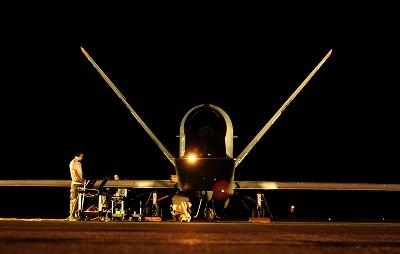
Air Force Global Hawk Becomes A Land And Sea Threat For The Air Force

The Air Force successfully completed the first Maritime Modes program risk reduction flight as the service moves toward providing a new air-sea battle surveillance capability.

The test flight, which took place in the airspace above the Navy's Point Mugu sea range in California, consisted of an 11 and a half hour sortie on a test Global Hawk Block 40 remotely piloted aircraft.

Maritime Modes is comprised of two components: a Maritime Moving Target Indicator and a Maritime Inverse Synthetic Aperture Radar, or MISAR, that function together to provide intelligence, surveillance and reconnaissance information on vessels traveling on the water's surface.

During the flight, the MISAR collected data on assets and moving targets on the water, ultimately testing more than 100 items of interest. Flight test data is being analyzed in order to determine initial performance, stability and necessary fixes before entering the development test and evaluation phase.

Currently, RQ-4B Global Hawks are the only aircraft equipped with the MP-RTIP radar system.

"This capability will augment the MP-RTIP's existing ground surveillance and provide the warfighter with a complete ground, coastal and open seas picture," said Frank Hertler, the Maritime Modes program manager. "The system will be able to detect, track, classify and build a profile from where the vessel came from as well as have the ability to see much smaller marine vehicles."

(Image provided by U.S Air Force)

FMI: www.airforce.com

Advertisement

More News

ANN's Daily Aero-Term (12.01.25): Convective SIGMET

Convective SIGMET A weather advisory concerning convective weather significant to the safety of all aircraft. Convective SIGMETs are issued for tornadoes, lines of thunderstorms, e>[...]

ANN's Daily Aero-Linx (12.01.25)

Aero Linx: United Flying Octogenarians WELCOME to a most extraordinary group of aviators, the United Flying Octogenarians (UFO). Founded in 1982 with just a handful of pilots, we h>[...]

NTSB Final Report: Remos Aircraft GmbH Remos GX

Pilot’s Decision To Attempt Takeoff With Frost Covering The Airplane’s Wings Analysis: The pilot of the light sport airplane was preparing to depart for a cross-country>[...]

Aero-News: Quote of the Day (12.02.25)

“We’ve paid for the cable line’s repair for the customer and have apologized for the inconvenience this caused them...” Source: Some followup info from an A>[...]

ANN's Daily Aero-Term (12.02.25): Coupled Approach

Coupled Approach An instrument approach performed by the aircraft autopilot, and/or visually depicted on the flight director, which is receiving position information and/or steerin>[...]

blog comments powered by Disqus



Advertisement

Advertisement

Podcasts

Advertisement

© 2007 - 2025 Web Development & Design by Pauli Systems, LC

