
NASA Extends Space Shuttle Main Engine Contract | Aero-News Network
Aero-News Network
RSS icon RSS feed
podcast icon MP3 podcast
Subscribe Aero-News e-mail Newsletter Subscribe

Airborne Unlimited -- Most Recent Daily Episodes

Episode Date

Airborne-Monday

Airborne-Tuesday

Airborne-Wednesday Airborne-Thursday

Airborne-Friday

Airborne On YouTube

Airborne-Unlimited-12.01.25

AirborneNextGen-
12.02.25

Airborne-Unlimited-12.03.25

Airborne-AffordableFlyers-11.20.25

AirborneUnlimited-11.21.25

LIVE MOSAIC Town Hall (Archived): www.airborne-live.net

Sun, Aug 05, 2007

NASA Extends Space Shuttle Main Engine Contract

Maintenance To Extend Until Retirement

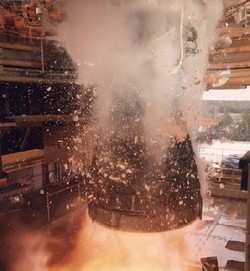
This week, NASA signed a $975 million contract extension with Pratt and Whitney Rocketdyne Inc., of Canoga Park, CA to maintain the agency's fleet of space shuttle main engines until the orbiter is retired in 2010.

The contract began on April 1, 2006. It is scheduled to conclude September 30, 2010. The $975 million contract extension brings the total value of the cost- plus-award/incentive fee contract to slightly more than $2.05 billion.

Pratt and Whitney Rocketdyne supports the Shuttle Propulsion Office at NASA's Marshall Space Flight Center in Huntsville, AL; the Space Shuttle Program Office at NASA's Johnson Space Center in Houston; and the Space Operations Mission Directorate at NASA Headquarters in Washington.

The contract includes maintenance and refurbishment of existing shuttle main engines at NASA's Kennedy Space Center, FL.

Each space shuttle is powered by three main engines -- the world's only reusable rocket engines. During launch, each of the 7,750-pound engines burns liquid hydrogen and liquid oxygen, fed from the shuttle's external fuel tank.

Each engine generates approximately 400,000 pounds of thrust, which works with the shuttle's twin solid rocket boosters to power the spacecraft to orbit.

FMI: www.nasa.gov/shuttle

Advertisement

More News

ANN's Daily Aero-Term (12.01.25): Convective SIGMET

Convective SIGMET A weather advisory concerning convective weather significant to the safety of all aircraft. Convective SIGMETs are issued for tornadoes, lines of thunderstorms, e>[...]

ANN's Daily Aero-Linx (12.01.25)

Aero Linx: United Flying Octogenarians WELCOME to a most extraordinary group of aviators, the United Flying Octogenarians (UFO). Founded in 1982 with just a handful of pilots, we h>[...]

NTSB Final Report: Remos Aircraft GmbH Remos GX

Pilot’s Decision To Attempt Takeoff With Frost Covering The Airplane’s Wings Analysis: The pilot of the light sport airplane was preparing to depart for a cross-country>[...]

Aero-News: Quote of the Day (12.02.25)

“We’ve paid for the cable line’s repair for the customer and have apologized for the inconvenience this caused them...” Source: Some followup info from an A>[...]

ANN's Daily Aero-Term (12.02.25): Coupled Approach

Coupled Approach An instrument approach performed by the aircraft autopilot, and/or visually depicted on the flight director, which is receiving position information and/or steerin>[...]

blog comments powered by Disqus



Advertisement

Advertisement

Podcasts

Advertisement

© 2007 - 2025 Web Development & Design by Pauli Systems, LC

