

Astronaut Assistant CIMON Wins Prestigious German Innovation Prize | Aero-News Network
Aero-News Network
RSS icon RSS feed
podcast icon MP3 podcast
Subscribe Aero-News e-mail Newsletter Subscribe

Airborne Unlimited -- Most Recent Daily Episodes

Episode Date

Airborne-Monday

Airborne-Tuesday

Airborne-Wednesday Airborne-Thursday

Airborne-Friday

Airborne On YouTube

Airborne-Unlimited-12.08.25

AirborneNextGen-
12.09.25

Airborne-Unlimited-12.10.25

Airborne-AffordableFlyers-12.11.25

AirborneUnlimited-12.12.25

AFE 2025 LIVE MOSAIC Town Hall (Archived): www.airborne-live.net

Sun, Apr 07, 2019

Astronaut Assistant CIMON Wins Prestigious German Innovation Prize

Recognized For Forward-Looking Innovation By A German Company

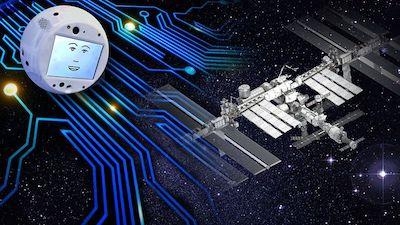
CIMON, the technology demonstrator developed and built by Airbus on behalf of the German Aerospace Center (Deutsches Zentrum für Luft- und Raumfahrt; DLR), has won the prestigious German Innovation Prize (Deutsche Innovationspreis) in the large companies category (Großunternehmen) 2019. The award was presented in Munich last Friday.

Every year, Accenture, EnBW and the business magazine WirtschaftsWoche, which joined forces to launch the German Innovation Award, recognize outstanding, forward-looking innovations from German companies, which are transforming business and markets with their innovative strength.

CIMON (Crew Interactive MObile companioN), is the first free-flying astronaut assistant to be tested on board the International Space Station (ISS), and is a technology experiment designed to demonstrate how humans and intelligent machines can work together.

CIMON can see, hear, understand, speak and fly. It is spherical with a diameter of about one foot and weighs 11 pounds. It is modelled after a character from the 1980s anime series ‘Captain Future’, Professor Simon Wright, which was known as ‘the flying brain’ and featured sensors, cameras and a speech processor. On 15 November 2018, CIMON successfully completed its first 90-minute space mission with German ESA astronaut Alexander Gerst.

CIMON can support astronauts, for example by displaying and explaining procedures or instructions for scientific experiments and repairs. In particular, CIMON could be used in the future to complete routine tasks, such as documenting experiments, searching for items and taking inventory. It can also be used as a mobile camera. CIMON technology could also be useful here on Earth – assisting in industrial processes, in operating theatres or in the social sector.

The interactive astronaut assistant was developed and built by Airbus in Friedrichshafen and Bremen on behalf of the German Aerospace Center (Deutsches Zentrum für Luft- und Raumfahrt; DLR) Space Administration and funded by the German Federal Ministry for Economic Affairs and Energy (Bundesministerium für Wirtschaft und Energie; BMWi). Watson AI technology from the IBM Cloud provides voice-controlled artificial intelligence. The scientific aspects of the assistance system were co-developed and supervised by a team at Ludwig-Maximilian University Hospital in Munich (Klinikum der Ludwig-Maximilians-Universität München, LMU).

Currently, the CIMON team is analyzing the results of its first space mission, programming improvements and new tasks, and preparing the technology demonstrator for new work missions with new – human – colleagues.

(Images provided with Airbus news release)

FMI: www.airbus.com/search.html?q=CIMON&lang=de&newsroom=true

Advertisement

More News

ANN's Daily Aero-Term (12.13.25): Light Gun

Light Gun A handheld directional light signaling device which emits a brilliant narrow beam of white, green, or red light as selected by the tower controller. The color and type of>[...]

Aero-News: Quote of the Day (12.13.25)

“We have performed extensive ground testing by comparing warm up times, full power tethered pulls, and overall temperatures in 100 degree environments against other aircraft >[...]

NTSB Final Report: Gippsland GA-8

While Taxiing To Parking The Right Landing Gear Leg Collapsed, Resulting In Substantial Damage Analysis: The pilot made a normal approach with full flaps and landed on the runway. >[...]

Classic Aero-TV: Historically Unique -- Marlin Horst's Exquisite Fairchild 71

From 2014 (YouTube Edition): Exotic Rebuild Reveals Aerial Work Of Art During EAA AirVenture 2014, ANN's Michael Maya Charles took the time to get a history lesson about a great ai>[...]

Airborne 12.12.25: Global 8000, Korea Pilot Honors, AV-30 Update

Also: Project Talon, McFarlane Acquisition, Sky-Tec Service, JPL Earth Helo Tests Bombardier has earned a round of applause from the business aviation community, celebrating the fo>[...]

blog comments powered by Disqus



Advertisement

Advertisement

Podcasts

Advertisement

© 2007 - 2025 Web Development & Design by Pauli Systems, LC

