
Discovery Crew Conducts Final Heat Shield Analysis | Aero-News Network
Aero-News Network
RSS icon RSS feed
podcast icon MP3 podcast
Subscribe Aero-News e-mail Newsletter Subscribe

Airborne Unlimited -- Most Recent Daily Episodes

Episode Date

Airborne-Monday

Airborne-Tuesday

Airborne-Wednesday Airborne-Thursday

Airborne-Friday

Airborne On YouTube

Airborne-SpecialEpisode-12.15.25

AirborneNextGen-
12.16.25

Airborne-Unlimited-12.10.25

Airborne-AffordableFlyers-12.11.25

AirborneUnlimited-12.12.25

AFE 2025 LIVE MOSAIC Town Hall (Archived): www.airborne-live.net

Thu, Dec 21, 2006

Discovery Crew Conducts Final Heat Shield Analysis

Landing Scheduled For Friday

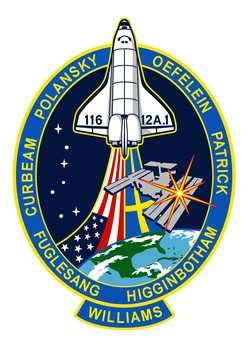
The STS-116 crew onboard the shuttle Discovery conducted a final inspection of the orbiter's heat shield Wednesday, in preparation for landing.

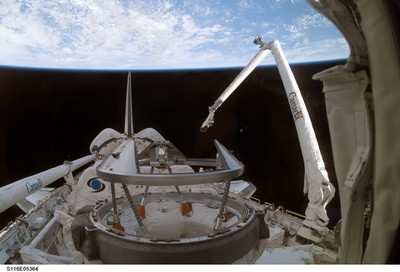
STS-116 Commander Mark Polansky, Pilot Bill Oefelein and Mission Specialist Nicholas Patrick used the shuttle’s robotic arm and boom extension sensor system to check the heat shield for any space junk or micrometeoroid hits that may have occurred while the orbiter was docked to the International Space Station.

Mission Specialists Bob Curbeam, Christer Fuglesang, Joan Higginbotham and Thomas Reiter are stowing items in preparation for the return to Earth. Discovery is slated to touch down at 3:56 pm EST Friday at Florida's Kennedy Space Center... but weather could force a delay, or a landing at an alterate site in New Mexico or California.

Two small scientific satellites were deployed from the payload bay Wednesday night. The Microelectromechanical System-Based PICOSAT Inspector (MEPSI) mini-satellite was released at 7:16 pm. MEPSI will demonstrate the use of tiny, low-power satellites to observe larger spacecraft by testing the function of small camera systems and gyroscopes.

The Radar Fence Transponder (RAFT) satellite was released 90 minutes later, at 8:56 pm. RAFT is a student experiment from the United States Naval Academy that uses picosatellites to test the Space Surveillance Radar Fence.

As Aero-News reported, Discovery undocked from the station Tuesday, ending an eight-day stay at the orbital outpost. While there, the crew continued the on-orbit construction of the station with the addition of the P5 spacer truss segment during the first of four spacewalks. The next two spacewalks were devoted to the rewiring of the station’s power system, leaving it in a permanent setup. A fourth spacewalk was added to allow the crew to retract solar arrays that had folded improperly.

Discovery also delivered a new crew member and more than two tons of equipment and supplies to the station. Almost two tons of items no longer needed on the station will return to Earth with STS-116.

European Space Agency astronaut Reiter is also returning with the Discovery crew, after his six month stay onboard the ISS as a member of both Expedition 13 and Expedition 14 crews.

FMI: www.nasa.gov/shuttle

Advertisement

More News

Aero-News: Quote of the Day (12.18.25)

“These new aircraft strengthen our ability to respond quickly, train effectively and support communities nationwide. Textron Aviation has been a steadfast supporter in helpin>[...]

Classic Aero-TV: Viking Twin Otter 400--Bringing the DHC-6 Back Into Production

From 2011 (YouTube Edition): Rugged, Legendary, STOL Twin Makes A Comeback The de Havilland Twin Otter is an airplane with a long history, and it gained a reputation as a workhorse>[...]

NTSB Final Report: Rans Employee Flying Club Rans S-6ES Coyote II

A Wind Gust Lifted The Right Wing And The Airplane Turned To The Left Analysis: The pilot was departing from a 2,395-ft-long by 50-ft-wide turf runway. The pilot reported that afte>[...]

ANN FAQ: Submit a News Story!

Have A Story That NEEDS To Be Featured On Aero-News? Here’s How To Submit A Story To Our Team Some of the greatest new stories ANN has ever covered have been submitted by our>[...]

ANN's Daily Aero-Term (12.18.25): Braking Action Advisories

Braking Action Advisories When tower controllers receive runway braking action reports which include the terms “medium," “poor," or “nil," or whenever weather con>[...]

blog comments powered by Disqus



Advertisement

Advertisement

Podcasts

Advertisement

© 2007 - 2025 Web Development & Design by Pauli Systems, LC

