Fri, Sep 12, 2008
Awaits Word From USAF On Production Go-Ahead
Boeing announced this week it has completed mission system
flight testing for Block 40/45, the largest upgrade in the history
of the US E-3 Airborne Warning and Control System (AWACS)
fleet.
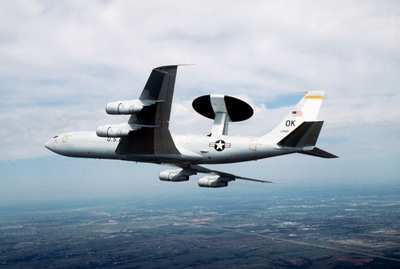
During a 15-month period from April 2007 to July 2008, Boeing
and the Air Force's Joint Test Force flew missions aboard Test
System 3, an AWACS test aircraft, to complete the System Design and
Development program.
"Test data indicate the Block 40/45 system meets or exceeds all
its key performance parameters and technical performance
requirements," said Stu Oliason, 40/45 System Design and
Development program manager for Boeing. "The success of this
flight-test program is a tribute to the hard work and dedication of
hundreds of 40/45 employees. We're all very excited about bringing
this new capability to the warfighter."
Under the Block 40/45 program, the aircraft's legacy mainframe
computer has been replaced with an open system architecture using
network servers in a user-friendly operating environment. The
vastly improved computing power helps automate what is currently a
manually intensive workload for the AWACS operators.
A multisource integration capability automates the process of
detecting and identifying targets to provide a
single-target/single-track resolution. Outgoing tasking messages
are automatically prioritized via a data link infrastructure.
Features are displayed to operators on the Primary AWACS Display in
a user-friendly, intuitive manner. The numerous buttons and
switches around the current operator console have been replaced
with point-and-click simplicity and a display featuring drop-down
menus and rapid access to all required information. This
functionality shortens the time required to execute either combat
or search-and-rescue missions.
The cumulative benefit of the Block 40/45 upgrade is to increase
overall mission effectiveness for AWACS operators in the
21st-century battlespace, while boosting the reliability of the
mission system and lowering life-cycle costs. The baseline
capability is designed to allow future upgrades.

The Air Force is expected to make a decision on the next step --
a Block 40/45 production contract -- by the end of this year.
More News
“We respectfully call on the City of Mesa to: 1. Withdraw the landing fee proposal immediately 2. Engage with the aviation community before making decisions that impact safet>[...]
High Speed Taxiway A long radius taxiway designed and provided with lighting or marking to define the path of aircraft, traveling at high speed (up to 60 knots), from the runway ce>[...]
Aero Linx: International Federation of Airworthiness (IFA) IFA uniquely combines together all those with responsibility for policies, principles and practices concerned with the co>[...]
Controller’s Expectation That VW02 Would Have Departed Sooner Led To An Inadequate Scan And Loss Of Situational Awareness Analysis: A Robinson R-44 helicopter N744AF, VW02 (V>[...]
A Few Questions AND Answers To Help You Get MORE Out of ANN! 1) I forgot my password. How do I find it? 1) Easy... click here and give us your e-mail address--we'll send it to you >[...]



 Aero-News: Quote of the Day (12.09.25)


 See All