
X-37B Orbital Test Vehicle Completes Mission Number 6 | Aero-News Network
Aero-News Network
RSS icon RSS feed
podcast icon MP3 podcast
Subscribe Aero-News e-mail Newsletter Subscribe

Airborne Unlimited -- Most Recent Daily Episodes

Episode Date

Airborne-Monday

Airborne-Tuesday

Airborne-Wednesday Airborne-Thursday

Airborne-Friday

Airborne On YouTube

Airborne-Unlimited-12.08.25

AirborneNextGen-
12.09.25

Airborne-Unlimited-12.10.25

Airborne-AffordableFlyers-12.11.25

AirborneUnlimited-12.12.25

AFE 2025 LIVE MOSAIC Town Hall (Archived): www.airborne-live.net

Thu, Nov 17, 2022

X-37B Orbital Test Vehicle Completes Mission Number 6

US Space Force Sees Success for Space Drone Experimentation

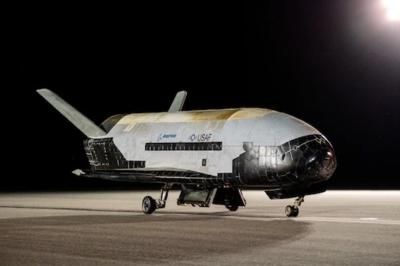
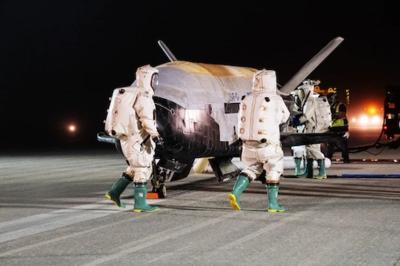
The Boeing X-37B Orbital Test Vehicle-6, or OTV-6, successfully deorbited and landed at NASA’s Kennedy Space Center Shuttle Landing Facility earlier this week, marking the 6th successful flight for the uncrewed, reusable spaceplane.

The mission was the first to include an attached service module, a modular, expandable system that will eventually add a range of capabilities to the X-37B should it enter service in earnest. The success bodes well for the program, showing that the test vehicle could successfully detach from the module prior to landing. The unit cannot remain onboard the X-37B during the landing process, requiring separate disposal in accordance with Space Force procedures.

Secretary of the Air Force Frank Kendall assures that the module will be taken care of. “The deliberate manner in which we conduct on­-orbit operations -to include the service module disposal— speaks to the United States' commitment to safe and responsible space practices, particularly as the issue of growing orbital debris threatens to impact global space operations.”

The attached module carried some experimental equipment from the Naval Research Laboratory, namely their Photovoltaic Radiofrequency Antenna Module, during its brief jaunt in space. That experiment successfully harnessed solar rays outside of Earth's atmosphere and aimed to transmit power to the ground in the form of radio frequency microwave energy. Additional NASA experiments were also along for the ride, testing the outcome of long-term exposure on seeds and new materials for future missions. The METIS-2 project will help to evaluate thermal control coatings, printed electronic materials, and new radiation shielding materials. The 6th mission conducted on-orbit experiments for 908 days in total. 

“The X-37B continues to push the boundaries of experimentation, enabled by an elite government and industry team behind the scenes,” said Joseph Fritschen, DAF Rapid Capabilities Office’s X-37B program director. “The ability to conduct on-orbit experiments and bring them home safely for in-depth analysis on the ground has proven valuable for the Department of the Air Force and scientific community. The addition of the service module on OTV-6 allowed us to host more experiments than ever before.”

“This mission highlights the Space Force's focus on collaboration in space exploration and expanding low-cost access to space for our partners, within and outside of the Department of the Air Force,” said Chief of Space Operations General B. Chance Saltzman.

FMI: www.af.mil

Advertisement

More News

Aero-News: Quote of the Day (12.09.25)

“We respectfully call on the City of Mesa to: 1. Withdraw the landing fee proposal immediately 2. Engage with the aviation community before making decisions that impact safet>[...]

ANN's Daily Aero-Term (12.09.25): High Speed Taxiway

High Speed Taxiway A long radius taxiway designed and provided with lighting or marking to define the path of aircraft, traveling at high speed (up to 60 knots), from the runway ce>[...]

ANN's Daily Aero-Linx (12.09.25)

Aero Linx: International Federation of Airworthiness (IFA) IFA uniquely combines together all those with responsibility for policies, principles and practices concerned with the co>[...]

NTSB Final Report: Diamond Aircraft Ind Inc DA20C1 (A1); Robinson Helicopter R44

Controller’s Expectation That VW02 Would Have Departed Sooner Led To An Inadequate Scan And Loss Of Situational Awareness Analysis: A Robinson R-44 helicopter N744AF, VW02 (V>[...]

ANN FAQ: Q&A 101

A Few Questions AND Answers To Help You Get MORE Out of ANN! 1) I forgot my password. How do I find it? 1) Easy... click here and give us your e-mail address--we'll send it to you >[...]

blog comments powered by Disqus



Advertisement

Advertisement

Podcasts

Advertisement

© 2007 - 2025 Web Development & Design by Pauli Systems, LC

