
Uncertainty Surrounds Recovery Of Navy Fighter Jet | Aero-News Network
Aero-News Network
RSS icon RSS feed
podcast icon MP3 podcast
Subscribe Aero-News e-mail Newsletter Subscribe

Airborne Unlimited -- Most Recent Daily Episodes

Episode Date

Airborne-Monday

Airborne-Tuesday

Airborne-Wednesday Airborne-Thursday

Airborne-Friday

Airborne On YouTube

Airborne-Unlimited-12.01.25

AirborneNextGen-
12.02.25

Airborne-Unlimited-11.19.25

Airborne-AffordableFlyers-11.20.25

AirborneUnlimited-11.21.25

LIVE MOSAIC Town Hall (Archived): www.airborne-live.net

Sat, Jan 04, 2025

Uncertainty Surrounds Recovery Of Navy Fighter Jet

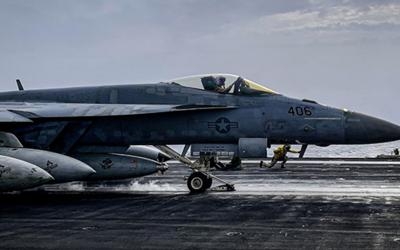
F/A-18 Super Hornet Downed By Friendly Fire Over Red Sea

The U.S. Navy is still trying to decide whether or not to recover the F/A-18 Super Hornet that was downed by a surface-to-air missile in an apparent friendly fire incident on December 22, 2024. Several factors are complicating the decision, including the possibility of Houthi attacks on salvage operations.

The aircraft was launched from the carrier USS Harry S. Truman and was conducting strikes against Yemen’s Houthi rebels when it was struck by a missile from the guided-missile cruiser USS Gettysburg, which is part of the Harry S. Truman’s carrier group. The pilot and weapons system officer ejected from the aircraft and were recovered safely.

Although the Super Hornets are being phased out, the newer Block III aircraft have upgraded equipment such as an infrared sensing system and improved radar that adversaries might be tempted to recover. It is not yet known if the aircraft was a Block III or perhaps had upgraded equipment.

Steven Wills, a naval analyst with the Center for Maritime Strategy at the Navy League of the United States said, “There would perhaps be sensitive material onboard … worth recovery, but it depends on the condition of the aircraft and where it went down in the Red Sea.”

The aircraft may have been destroyed, so salvage operations may not be warranted or even possible, but this too is unknown. In addition, the wreckage may be too scattered to recover efficiently. Further, although a large portion of the Red Sea is relatively shallow, there are deep trenches that would make salvage more challenging.

Wills continued, “Much of the Red Sea is relatively shallow ... but there are some deep trenches that are very deep. The U.S. has recovered downed intact aircraft in the past, but recovery of wreckage perhaps strewn over miles of seabed would be a challenge.”

FMI:  www.navy.mil

Advertisement

More News

NTSB Prelim: Cirrus Design Corp SR20

The Airplane Made An Uncommanded Right Yaw And Roll, And He Was Unable To Maintain Control Of The Airplane On November 11, 2025, about 1750 central standard time, a Cirrus SR20, N8>[...]

ANN's Daily Aero-Linx (11.30.25)

Aero Linx: Florida Antique Biplane Association "Biplanes.....outrageous fun since 1903." That quote really defines what the Florida Antique Biplane Association (FABA) is all about.>[...]

ANN's Daily Aero-Term (11.30.25): Wind Shear Escape

Wind Shear Escape An unplanned abortive maneuver initiated by the pilot in command (PIC) as a result of onboard cockpit systems. Wind shear escapes are characterized by maximum thr>[...]

Aero-News: Quote of the Day (11.30.25)

“Working closely with the Polish Armed Forces, we’re focused on disciplined execution to help enhance Poland’s defense capabilities and keep up with the strong de>[...]

Airborne 11.26.25: Bonanza-Baron Fini, Archer v LA NIMBYs, Gogo Loses$$$

Also: Bell 505 on SAF, NYPA Gets Flak For BizAv 'Abuse', FAA Venezuela Caution, Horizon Update Textron Aviation has confirmed it will be ending production of the Beechcraft Bonanza>[...]

blog comments powered by Disqus



Advertisement

Advertisement

Podcasts

Advertisement

© 2007 - 2025 Web Development & Design by Pauli Systems, LC

