New Supplies Arrived Friday Night In Trouble-Free Docking
More than 2.5 tons of food, fuel and supplies arrived at the
International Space Station Friday night, as an unpiloted Russian
cargo spacecraft docked to the Pirs Docking Compartment.
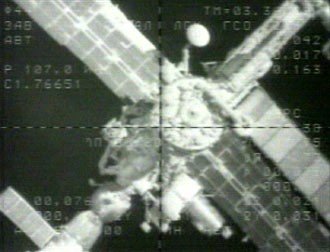
NASA reports the ISS Progress 24 automatically docked to
Pirs at 8:59 p.m. CST (5:59 a.m. Moscow time Saturday) as the
station flew 220 miles above the South Atlantic off the southeast
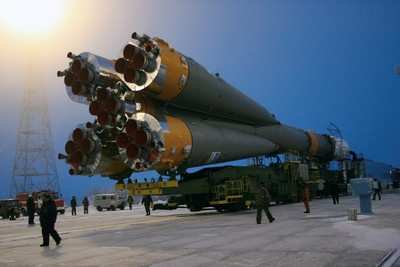
coast of Uruguay. The 24th Progress to visit the station launched Wednesday night from
the Baikonur Cosmodrome in Kazakhstan.
Unlike its predecessor, Progress 24 linked up to the station
after its automated rendezvous antenna retracted as planned in the
final 50 meters prior to docking. As Aero-News reported, on
October 26 the automated navigation antenna on the Progress 23
failed to retract.
Expedition 14 Commander Mike Lopez-Alegria and Flight Engineer
Mikhail Tyurin will conduct a spacewalk in late February to
manually retract and tie down the antenna before the older Progress
undocks from the aft port of the Zvezda service module in early
April.
The crew will open the hatch to the new Progress overnight and
deactivate the systems of the newly arrived craft before its cargo
is unloaded over the next few weeks. Progress 24 holds 1,720 pounds
of propellant for the Russian thrusters, 110 pounds of oxygen and
almost 3,300 pounds of spare parts, experiment hardware and life
support components.
In addition to preparing for the cargo ship’s arrival, the
Expedition 14 crew worked this week on a variety of station
maintenance tasks and science experiments. Lopez-Alegria and Flight
Engineer Suni Williams reported what they ate and drank, and
collected blood and urine samples as part of an experiment know as
Nutrition. The experiment looks at how the human body processes
nutrients in microgravity.
Lopez-Alegria replaced limited-life components in the Volatile
Organic Analyzer (VOA), part of the Crew Health Care System. The
VOA is a gas analysis system used to assess the levels of organic
compounds in the station atmosphere, some of which could become
harmful to the crew in high concentrations. The old components will
be returned to Earth on the next shuttle mission.
Williams focused on work with lentil seedlings as part of an
experiment called Threshold Acceleration for Gravisensing, or
“Gravi.” The experiment uses a European Modular
Cultivation System centrifuge to document the effects of varying
levels of gravity on the development of plant roots with an eye
toward growing edible plants for future, long-duration
spaceflights.
Tyruin worked with a number of Russian experiments, including an
instrumented workout on a stationary bicycle to collect data on
ways to limit bone and muscle density loss associated with
long-duration spaceflights.
All three crew members also spoke with experts on the ground
planning the upcoming Expedition 14 spacewalks. Lopez-Alegria,
Tyurin and Williams will begin on-board preparations for those
spacewalks along with a fourth to remove the navigation antenna
from Progress 23. The first three spacewalks by Lopez-Alegria and
Williams are designed to continue outfitting the newly activated
cooling systems for the station’s truss and to continue
preparations for the relocation of the P6 solar array truss
structure.



 ANN's Daily Aero-Term (12.19.25): Ultrahigh Frequency (UHF)


 See All