Tue, May 03, 2011
First Russian-Designed Spacecraft To Launch From French
Guiana
The latest addition to Arianespace's launcher family made its
world debut Monday at the vehicle's new base of operations, as the
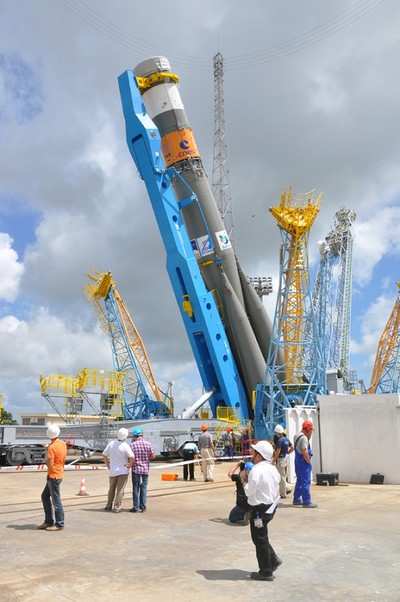
first Soyuz was rolled out to the Spaceport's launch pad in French
Guiana. The Russian-built medium-lift workhorse vehicle emerged
from its MIK integration facility in the Spaceport's northwest zone
early Monday morning for a 1,900 foot transfer to the launch
zone.
It marked the start of a "dry run" validation of procedures that
will replicate all aspects of a Soyuz mission's typical multi-day
final preparation phase at the Spaceport - except for the vehicle's
actual fueling. For this dry run, the process will continue to the
final countdown on May 4, when it will be purposely stopped -
allowing procedures to be confirmed in the scenario of a launch-day
interruption. The final countdown will be resumed on May 5, with a
simulated liftoff and downrange mission trajectory.
The vehicle involved in this exercise is a flight-worthy
launcher that will be used for a future mission after Soyuz enters
service beginning later this year. It is one of two launchers that
have been delivered from Russia to French Guiana. Based on the
processing flow established for Soyuz missions at the Spaceport,
the three-stage launcher had been horizontally integrated in the
MIK facility and was rolled out to the launch zone on a
transporter/erector rail car.
The Soyuz vehicle - composed of its four first-stage strap-on
boosters, the Block A core second stage, and the Block I third
stage - was then raised into position over the massive concrete
launch pad by the transporter/erector, where it was then suspended
in position with the use of the launch pad's four primary support
arms at mid-day.

During the afternoon hours, the 170-foot-tall mobile gantry that
was developed specifically for Soyuz operations at the Spaceport
moved into position around the vehicle, allowing delivery and
integration of the launcher's upper composite in the evening. This
upper composite consists of a Fregat upper stage and the ST-type
payload fairing. For the dry-run exercise, the upper composite did
not contain an actual payload.
More News
The Airplane Made An Uncommanded Right Yaw And Roll, And He Was Unable To Maintain Control Of The Airplane On November 11, 2025, about 1750 central standard time, a Cirrus SR20, N8>[...]
Aero Linx: Florida Antique Biplane Association "Biplanes.....outrageous fun since 1903." That quote really defines what the Florida Antique Biplane Association (FABA) is all about.>[...]
Wind Shear Escape An unplanned abortive maneuver initiated by the pilot in command (PIC) as a result of onboard cockpit systems. Wind shear escapes are characterized by maximum thr>[...]
“Working closely with the Polish Armed Forces, we’re focused on disciplined execution to help enhance Poland’s defense capabilities and keep up with the strong de>[...]
Also: Bell 505 on SAF, NYPA Gets Flak For BizAv 'Abuse', FAA Venezuela Caution, Horizon Update Textron Aviation has confirmed it will be ending production of the Beechcraft Bonanza>[...]



 NTSB Prelim: Cirrus Design Corp SR20


 See All