Sun, May 04, 2008
Can Travel 125 Miles From 30,000 Feet... At 135 MPH
Don't confuse the next item with the opening of the film "Iron
Man" this weekend -- this is the real deal. It may not outrun a
Raptor... but its agility and stealth could revolutionize skydiving
as a sport, and eventually see its way to combat.
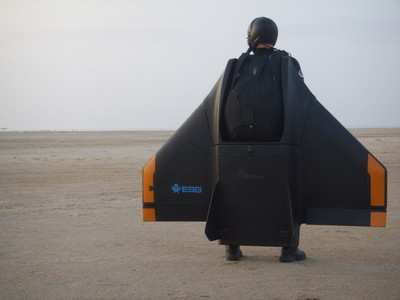
The Gryphon attack glider designed by SPELCO GbR weighs only 30
pounds and has a 6-foot swept-wing that is steered with handheld
rotary controls connected to its rudder. It can be fully weaponized
for assault and hide more than 100 pounds of combat gear in a
built-in compartment.
Designed to penetrate combat zones at 135 miles per hour, the
Gryphon is maneuverable enough to fly through the legs of Paris'
Eiffel Tower at high speed, as demonstrated through a simulation to
FOX News recently. The wing separates from the pack before the
parachute is deployed and remains connected via a cord, allowing it
to land before the pilot.
SPELCO hopes to offer the Gryphon to armed forces as a solution
to high altitude, high opening (HAHO) missions. Currently such
missions require jumps close to combat zones since traditional
parachutes only travel around 30 miles from the drop point to the
landing zone.
Future plans by SPELCO for the Gryphon include incorporation of
a small turbojet like those used for Unmanned Aerial Vehicle (UAV)
propulsion. Such an addition would eliminate the need to exit at a
high altitude to cover large distances... or, give soldiers added
time, and distance.
With its 5.1 glide ratio and on-board oxygen
system, a jet-powered Gryphon could allow soldiers to
exit up to 125 miles away from the landing zone at an altitude of
30,000 feet, far away from high-risk combat zones. The speed of the
Gryphon reduces the time of descent to from the typical 45 minutes
of a current HAHO mission to only 15 minutes -- significantly
reducing exposure to extreme cold at altitude, and possibility of
detection.
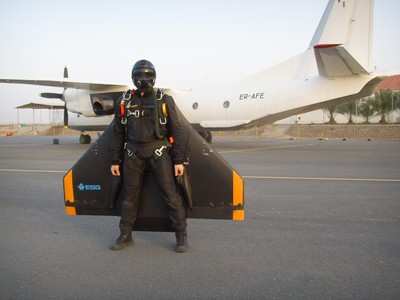
The compact design of the Gryphon with all equipment contained
within the lifting body gives the unit a very small radar
signature, making it an obvious choice for stealth missions.
More News
Convective SIGMET A weather advisory concerning convective weather significant to the safety of all aircraft. Convective SIGMETs are issued for tornadoes, lines of thunderstorms, e>[...]
Aero Linx: United Flying Octogenarians WELCOME to a most extraordinary group of aviators, the United Flying Octogenarians (UFO). Founded in 1982 with just a handful of pilots, we h>[...]
Pilot’s Decision To Attempt Takeoff With Frost Covering The Airplane’s Wings Analysis: The pilot of the light sport airplane was preparing to depart for a cross-country>[...]
“We’ve paid for the cable line’s repair for the customer and have apologized for the inconvenience this caused them...” Source: Some followup info from an A>[...]
Coupled Approach An instrument approach performed by the aircraft autopilot, and/or visually depicted on the flight director, which is receiving position information and/or steerin>[...]



 ANN's Daily Aero-Term (12.01.25): Convective SIGMET


 See All