
USAF Says 'Distorted Data' To Blame For Guam B-2 Accident | Aero-News Network
Aero-News Network
RSS icon RSS feed
podcast icon MP3 podcast
Subscribe Aero-News e-mail Newsletter Subscribe

Airborne Unlimited -- Most Recent Daily Episodes

Episode Date

Airborne-Monday

Airborne-Tuesday

Airborne-Wednesday Airborne-Thursday

Airborne-Friday

Airborne On YouTube

Airborne-Unlimited-12.01.25

AirborneNextGen-
12.02.25

Airborne-Unlimited-12.03.25

Airborne-FltTraining-12.04.25

AirborneUnlimited-12.05.25

AFE 2025 LIVE MOSAIC Town Hall (Archived): www.airborne-live.net

Fri, Jun 06, 2008

USAF Says 'Distorted Data' To Blame For Guam B-2 Accident

Moisture In Transducers Led To Flight Control Errors

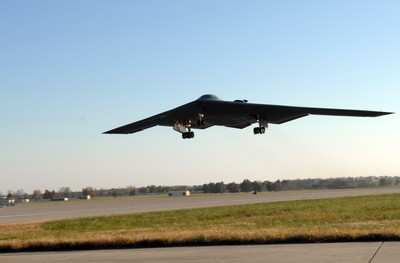
The US Air Force says distorted data introduced by a B-2 Spirit's air data system skewed information entering the bomber's flight control computers, ultimately causing the crash of the aircraft on takeoff at Andersen Air Force Base, Guam, February 23. That's the conclusion reached in an Air Combat Command accident investigation report released Thursday.

Moisture in the aircraft's Port Transducer Units during air data calibration distorted the information in the bomber's air data system, causing the flight control computers to calculate an inaccurate airspeed and a negative angle of attack upon takeoff.

According to the report, this caused an, "uncommanded 30 degree nose-high pitch-up on takeoff, causing the aircraft to stall and its subsequent crash."

Earlier reports stating a fire onboard may have contributed to the crash were apparently erroneous. Instead, the USAF says, moisture in the PTUs, inaccurate airspeed, a negative AOA calculation and low altitude/low airspeed were substantially contributing factors in the mishap.

Another substantially contributing factor was the ineffective communication of critical information regarding a suggested technique of turning on pitot heat in order to remove moisture from the PTUs prior to performing an air data calibration.

The pilot received minor injuries, and the co-pilot received a spinal compression fracture during ejection. He was treated at Tripler Army Medical Center, Hawaii, and released. The aircraft was assigned to the 509th Bomb Wing at Whiteman Air Force Base, MO.

The cost of the lost aircraft is about $1.4 billion.

FMI: www.langley.af.mil

Advertisement

More News

ANN's Daily Aero-Linx (12.03.25)

Aero Linx: American Aviation Historical Society AAHS is dedicated to the preservation and dissemination of the rich heritage of American aviation. Our purpose is to collect, preser>[...]

ANN's Daily Aero-Term (12.03.25): CrewMember (UAS)

CrewMember (UAS) A person assigned to perform an operational duty. A UAS crewmember includes the remote pilot in command, the person manipulating the controls, and visual observers>[...]

NTSB Prelim: Maule M-7-235A

Immediately After The Right Main Tire Contacted The Runway Surface, The Right Main Landing Gear Failed On October 31, 2025, at about 1227 Pacific daylight time, a Maule M-7-235A, N>[...]

Airborne-Flight Training 12.04.25: Ldg Fee Danger, Av Mental Health, PC-7 MKX

Also: IAE Acquires Diamond Trainers, Army Drones, FedEx Pilots Warning, DA62 MPP To Dresden Tech Uni The danger to the flight training industry and our future pilots is clear. Dona>[...]

Aero-News: Quote of the Day (12.04.25)

"On December 3, 2025, at approximately 10:45 a.m., a Thunderbird pilot ejected safely from a F-16C Fighting Falcon aircraft during a training mission over controlled airspace in Ca>[...]

blog comments powered by Disqus



Advertisement

Advertisement

Podcasts

Advertisement

© 2007 - 2025 Web Development & Design by Pauli Systems, LC

