
Phoenix Lander Collects First Mars Samples | Aero-News Network
Aero-News Network
RSS icon RSS feed
podcast icon MP3 podcast
Subscribe Aero-News e-mail Newsletter Subscribe

Airborne Unlimited -- Most Recent Daily Episodes

Episode Date

Airborne-Monday

Airborne-Tuesday

Airborne-Wednesday Airborne-Thursday

Airborne-Friday

Airborne On YouTube

Airborne-Unlimited-12.01.25

AirborneNextGen-
12.02.25

Airborne-Unlimited-11.19.25

Airborne-AffordableFlyers-11.20.25

AirborneUnlimited-11.21.25

LIVE MOSAIC Town Hall (Archived): www.airborne-live.net

Tue, Jun 03, 2008

Phoenix Lander Collects First Mars Samples

Practice Scraping Shows Possible Evidence Of Ice, Salt

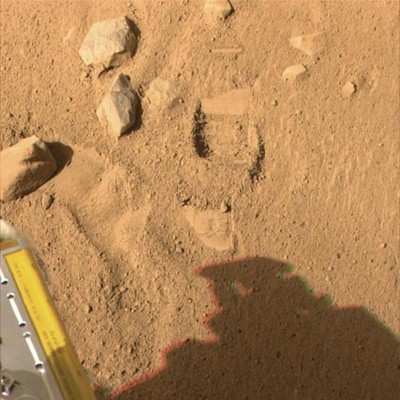
One week after landing on far-northern Mars, on Sunday NASA Phoenix spacecraft lifted its first scoop of Martian soil as a test of the lander's Robotic Arm.

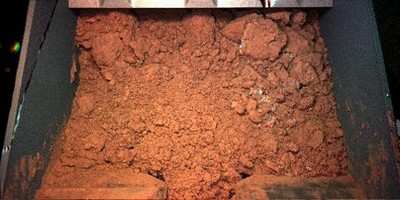
The practice scoop was emptied onto a designated dump area on the ground after the Robotic Arm Camera photographed the soil inside the scoop. The Phoenix team plans to have the arm deliver its next scoopful, later this week, to an instrument that heats and sniffs the sample to identify ingredients.

A glint of bright material appears in the scooped up soil and in the hole from which it came. "That bright material might be ice or salt. We're eager to do testing of the next three surface samples collected nearby to learn more about it," said Ray Arvidson of Washington University in St. Louis, Phoenix co-investigator for the Robotic Arm.

The camera on the arm examined the lander's first scoop of Martian soil. "The camera has its own red, green and blue lights, and we combine separate images taken with different illumination to create color images," said the University of Arizona's Pat Woida, senior engineer on the Phoenix team.

The Phoenix mission is led by Peter Smith at the University of Arizona with project management by NASA's Jet Propulsion Laboratory, Pasadena, CA and development partnership at Lockheed Martin, Denver. International contributions come from the Canadian Space Agency; the University of Neuchatel, Switzerland; the universities of Copenhagen and Aarhus, Denmark; Max Planck Institute, Germany; and the Finnish Meteorological Institute.

FMI: www.nasa.gov/phoenix and http://phoenix.lpl.arizona.edu

Advertisement

More News

NTSB Prelim: Cirrus Design Corp SR20

The Airplane Made An Uncommanded Right Yaw And Roll, And He Was Unable To Maintain Control Of The Airplane On November 11, 2025, about 1750 central standard time, a Cirrus SR20, N8>[...]

ANN's Daily Aero-Linx (11.30.25)

Aero Linx: Florida Antique Biplane Association "Biplanes.....outrageous fun since 1903." That quote really defines what the Florida Antique Biplane Association (FABA) is all about.>[...]

ANN's Daily Aero-Term (11.30.25): Wind Shear Escape

Wind Shear Escape An unplanned abortive maneuver initiated by the pilot in command (PIC) as a result of onboard cockpit systems. Wind shear escapes are characterized by maximum thr>[...]

Aero-News: Quote of the Day (11.30.25)

“Working closely with the Polish Armed Forces, we’re focused on disciplined execution to help enhance Poland’s defense capabilities and keep up with the strong de>[...]

Airborne 11.26.25: Bonanza-Baron Fini, Archer v LA NIMBYs, Gogo Loses$$$

Also: Bell 505 on SAF, NYPA Gets Flak For BizAv 'Abuse', FAA Venezuela Caution, Horizon Update Textron Aviation has confirmed it will be ending production of the Beechcraft Bonanza>[...]

blog comments powered by Disqus



Advertisement

Advertisement

Podcasts

Advertisement

© 2007 - 2025 Web Development & Design by Pauli Systems, LC

