
SpaceX Conducts First Five-Engine Firing of Falcon 9 Rocket | Aero-News Network
Aero-News Network
RSS icon RSS feed
podcast icon MP3 podcast
Subscribe Aero-News e-mail Newsletter Subscribe

Airborne Unlimited -- Most Recent Daily Episodes

Episode Date

Airborne-Monday

Airborne-Tuesday

Airborne-Wednesday Airborne-Thursday

Airborne-Friday

Airborne On YouTube

Airborne-Unlimited-12.01.25

AirborneNextGen-
12.02.25

Airborne-Unlimited-11.19.25

Airborne-AffordableFlyers-11.20.25

AirborneUnlimited-11.21.25

LIVE MOSAIC Town Hall (Archived): www.airborne-live.net

Wed, Jun 04, 2008

SpaceX Conducts First Five-Engine Firing of Falcon 9 Rocket

Engines Generated Nearly Half A Million Pounds Of Force

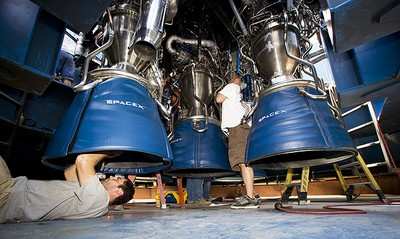
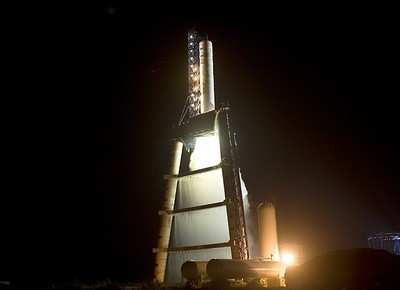
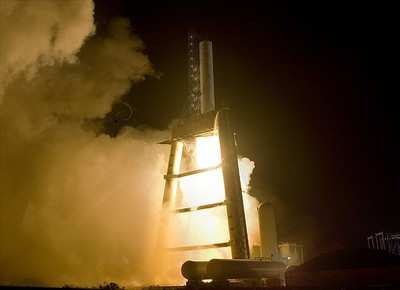
Space Exploration Technologies Corp. (SpaceX) conducted the first five-engine firing of its Falcon 9 medium to heavy lift rocket at its Texas Test Facility outside McGregor on Thursday, May 29. At full power the engines generated almost half a million pounds of force, and consumed 1,750 lbs of fuel and liquid oxygen per second.

The five engine test set the record as the most powerful test yet on the towering 235-foot tall test stand.

The test of the five Merlin 1C engines, arranged in a cross pattern like the Saturn V moon rocket, is the last step before firing the full complement of nine engines, scheduled for this summer. With all engines operating, the Falcon 9 generates over one million pounds of thrust in vacuum - four times the maximum thrust of a 747 aircraft.

"This is the first time that we’ve added more than one engine at a time, and all phases of integration and testing went smoothly," said Tom Mueller, Vice President of Propulsion for SpaceX. "As with previous tests, we saw no unexpected interactions between the engines, and are on schedule for adding four more engines."

The first Falcon 9 will arrive at the SpaceX launch site at Cape Canaveral by the end of 2008. The next flight of SpaceX’s smaller Falcon 1 rocket is scheduled for late June or July of 2008.

SpaceX is developing a family of launch vehicles intended to reduce the cost and increase the reliability of both manned and unmanned space transportation ultimately by a factor of ten. With its Falcon line of launch vehicles, powered by the internally developed Merlin engine, SpaceX is able to offer light, medium and heavy lift capabilities to deliver spacecraft into any inclination and altitude, from low-Earth orbit to geosynchronous orbit to planetary missions.

FMI: www.spacex.com

Advertisement

More News

ANN's Daily Aero-Term (12.01.25): Convective SIGMET

Convective SIGMET A weather advisory concerning convective weather significant to the safety of all aircraft. Convective SIGMETs are issued for tornadoes, lines of thunderstorms, e>[...]

ANN's Daily Aero-Linx (12.01.25)

Aero Linx: United Flying Octogenarians WELCOME to a most extraordinary group of aviators, the United Flying Octogenarians (UFO). Founded in 1982 with just a handful of pilots, we h>[...]

NTSB Final Report: Remos Aircraft GmbH Remos GX

Pilot’s Decision To Attempt Takeoff With Frost Covering The Airplane’s Wings Analysis: The pilot of the light sport airplane was preparing to depart for a cross-country>[...]

Aero-News: Quote of the Day (12.02.25)

“We’ve paid for the cable line’s repair for the customer and have apologized for the inconvenience this caused them...” Source: Some followup info from an A>[...]

ANN's Daily Aero-Term (12.02.25): Coupled Approach

Coupled Approach An instrument approach performed by the aircraft autopilot, and/or visually depicted on the flight director, which is receiving position information and/or steerin>[...]

blog comments powered by Disqus



Advertisement

Advertisement

Podcasts

Advertisement

© 2007 - 2025 Web Development & Design by Pauli Systems, LC

