F-4 Continues Long-Time Service To AF With New Mission
The 82nd Aerial Target Squadron officials at Tyndal AFB in
Florida are replacing the Lear jets used for banner tow missions
with the F-4 Phantom, creating an air-to-air target that aircrews
in training can safely evaluate, develop and test their weapons
systems.
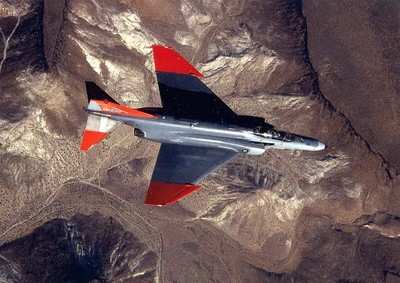
USAF Photo
"We developed the idea to use the F-4 for the banner tow
missions to ensure our combat fighter aircrews could continue
training and developing their aerial gunnery skills," said Lt. Col.
Ryan Luchsinger, the 82nd ATRS commander. "Due to costs, the Navy
contract for use of the Lear jets was being cut, and we had no
other way to accomplish this training. The F-4 was the perfect
platform to tow the banner and ensure we kept their aerial gunnery
proficiency."
The F-4 models in use by the 82nd ATRS range in age from 36 to
42 years old and are flown and maintained here. New procedures for
attaching the banner to the jet had to be developed to ensure
safety and effectiveness.
"We did our research and came up with new procedures for
attaching the banner," said Maj. William Hope, the 53rd Test
Support Squadron Assistant Director of Operations and the F-4
banner tow project manager. "We adapted them from an old Navy
banner tow system of another F-4 model and made some minor changes
to the equipment to make it safer as well. Using the F-4 provides
us with the capability to take advantage of training opportunities
that otherwise would not have been available to us."
The 60 foot-long banner is attached to the F-4 by specially
trained maintainers. "We attach the banner with a 120-foot chain to
1600 feet of cable so there is 1800 feet of clearance between the
jet and the banner," said Tech. Sgt. Phillip Praeger, with the 82nd
ATRS maintenance and logistics section. "This leaves plenty of room
between the banner and the F-4 in case the target is missed."
Lt. Col. Gregory Blount, the 82nd ATRS director of operations,
began flying the F-4's new mission two months ago. "We have a
special training program for pilots on Tyndall and we start with
the most experienced because it is a new program," he said. "This
is just another way the venerable Phantom continues to serve the
Air Force nearly 50 years after it began service."
The plane's new role ensures the Defense Department has
full-scale, air-to-air target training, ensuring continued
air dominance through highly specialized operational testing
and evaluation of weapons systems. "The 82nd ATRS operates the only
F-4 banner tow in the Defense Department," said Colonel Blount. "We
work in conjunction with the 83rd Fighter Weapons Squadron and we
fall under the 53rd Weapons Evaluations Group, also located on
Tyndall."
According to safety officials, all sorties are conducted over
water, far from shore. Officials work to ensure there are no stray
boaters in the impact area.Mission complete, the F-4 returns to
base and the banner is detached and evaluated for the number of
bulls-eye hits it came back with. Pilots have an opportunity to
evaluate how well they did, enhancing their training.
In addition to providing training, the F-4 banner tow mission is
a cost-saving initiative, saving the Air Force nearly $750,000 a
year. "This is an enormous benefit to our combat fighter aircrews
as well as to our cost-saving initiatives, because we are able to
accomplish critical aerial gunnery training while flying," Colonel
Luchsinger said.
The McDonnell Douglas-built aircraft is a two-seat, twin-engine,
all-weather, long-range supersonic jet interceptor and fighter. It
was originally developed for the Navy fleet defense in 1958,
however it was later adopted by the Marine Corps and the Air Force.
It has been in Air Force service since 1961 and was extensively
used by both the Navy and the Air Force during the Vietnam War.
Today, modified F-4s are in use as QF-4 reusable, full-scale target
drones.



 Aero-News: Quote of the Day (12.09.25)


 See All