
NASA Demonstrates In-Space Refueling Capabilities | Aero-News Network
Aero-News Network
RSS icon RSS feed
podcast icon MP3 podcast
Subscribe Aero-News e-mail Newsletter Subscribe

Airborne Unlimited -- Most Recent Daily Episodes

Episode Date

Airborne-Monday

Airborne-Tuesday

Airborne-Wednesday Airborne-Thursday

Airborne-Friday

Airborne On YouTube

Airborne-Unlimited-12.08.25

AirborneNextGen-
12.09.25

Airborne-Unlimited-12.10.25

Airborne-AffordableFlyers-12.11.25

AirborneUnlimited-12.12.25

AFE 2025 LIVE MOSAIC Town Hall (Archived): www.airborne-live.net

Tue, Feb 12, 2013

NASA Demonstrates In-Space Refueling Capabilities

Proves Viability Of Satellite-Servicing Technologies

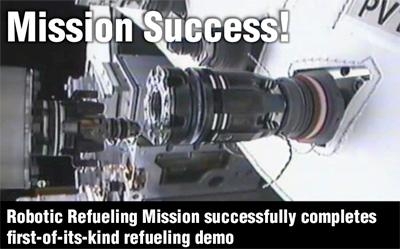
NASA has demonstrated robotic fluid transfer in space, an objective that will help inform the development of robotic technology to refuel satellites. The first-of-its-kind demonstration was performed during the Robotic Refueling Mission (RRM) aboard the International Space Station. "This achievement is a major step forward in servicing satellites," said Frank Cepollina, associate director of the Satellite Servicing Capabilities Office at NASA's Goddard Space Flight Center in Greenbelt, MD. "RRM gives NASA and the emerging commercial satellite servicing industry the confidence to robotically refuel, repair and maintain satellites in both near and distant orbits -- well beyond the reach of where humans can go today."

A joint effort with the Canadian Space Agency, RRM uses the International Space Station as test bed for the research and development of robotic satellite-servicing capabilities. During six days of activity last month, controllers on the ground at NASA's Johnson Space Center in Houston used the space station's remotely operated Dextre, a robotic space handyman, to cut wires, remove and stow caps and perform tasks necessary to refuel satellites not designed to be refueled.

The cutting-edge technologies that RRM is demonstrating could extend the lives of many of the hundreds of satellites currently in geosynchronous Earth orbit. These are satellites that deliver essential services such as weather reports, cell phone communications, television broadcasts, government communications and air traffic management.

RRM tasks scheduled to be performed later this year include thermal blanket cutting and fastener and electronic termination cap removals. NASA anticipates RRM technologies may help boost the commercial satellite-servicing industry in the future. Such servicing capabilities could greatly expand options for government and commercial fleet operators.

(Image provided by NASA)

FMI: http://ssco.gsfc.nasa.gov

Advertisement

More News

Aero-News: Quote of the Day (12.09.25)

“We respectfully call on the City of Mesa to: 1. Withdraw the landing fee proposal immediately 2. Engage with the aviation community before making decisions that impact safet>[...]

ANN's Daily Aero-Term (12.09.25): High Speed Taxiway

High Speed Taxiway A long radius taxiway designed and provided with lighting or marking to define the path of aircraft, traveling at high speed (up to 60 knots), from the runway ce>[...]

ANN's Daily Aero-Linx (12.09.25)

Aero Linx: International Federation of Airworthiness (IFA) IFA uniquely combines together all those with responsibility for policies, principles and practices concerned with the co>[...]

NTSB Final Report: Diamond Aircraft Ind Inc DA20C1 (A1); Robinson Helicopter R44

Controller’s Expectation That VW02 Would Have Departed Sooner Led To An Inadequate Scan And Loss Of Situational Awareness Analysis: A Robinson R-44 helicopter N744AF, VW02 (V>[...]

ANN FAQ: Q&A 101

A Few Questions AND Answers To Help You Get MORE Out of ANN! 1) I forgot my password. How do I find it? 1) Easy... click here and give us your e-mail address--we'll send it to you >[...]

blog comments powered by Disqus



Advertisement

Advertisement

Podcasts

Advertisement

© 2007 - 2025 Web Development & Design by Pauli Systems, LC

