
NASA Demonstrates In-Space Refueling Capabilities | Aero-News Network
Aero-News Network
RSS icon RSS feed
podcast icon MP3 podcast
Subscribe Aero-News e-mail Newsletter Subscribe

Airborne Unlimited -- Most Recent Daily Episodes

Episode Date

Airborne-Monday

Airborne-Tuesday

Airborne-Wednesday Airborne-Thursday

Airborne-Friday

Airborne On YouTube

Airborne-Unlimited-12.08.25

AirborneNextGen-
12.09.25

Airborne-Unlimited-12.10.25

Airborne-AffordableFlyers-12.11.25

AirborneUnlimited-12.12.25

AFE 2025 LIVE MOSAIC Town Hall (Archived): www.airborne-live.net

Tue, Feb 12, 2013

NASA Demonstrates In-Space Refueling Capabilities

Proves Viability Of Satellite-Servicing Technologies

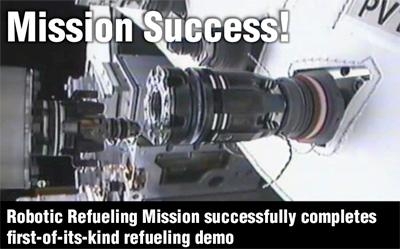
NASA has demonstrated robotic fluid transfer in space, an objective that will help inform the development of robotic technology to refuel satellites. The first-of-its-kind demonstration was performed during the Robotic Refueling Mission (RRM) aboard the International Space Station. "This achievement is a major step forward in servicing satellites," said Frank Cepollina, associate director of the Satellite Servicing Capabilities Office at NASA's Goddard Space Flight Center in Greenbelt, MD. "RRM gives NASA and the emerging commercial satellite servicing industry the confidence to robotically refuel, repair and maintain satellites in both near and distant orbits -- well beyond the reach of where humans can go today."

A joint effort with the Canadian Space Agency, RRM uses the International Space Station as test bed for the research and development of robotic satellite-servicing capabilities. During six days of activity last month, controllers on the ground at NASA's Johnson Space Center in Houston used the space station's remotely operated Dextre, a robotic space handyman, to cut wires, remove and stow caps and perform tasks necessary to refuel satellites not designed to be refueled.

The cutting-edge technologies that RRM is demonstrating could extend the lives of many of the hundreds of satellites currently in geosynchronous Earth orbit. These are satellites that deliver essential services such as weather reports, cell phone communications, television broadcasts, government communications and air traffic management.

RRM tasks scheduled to be performed later this year include thermal blanket cutting and fastener and electronic termination cap removals. NASA anticipates RRM technologies may help boost the commercial satellite-servicing industry in the future. Such servicing capabilities could greatly expand options for government and commercial fleet operators.

(Image provided by NASA)

FMI: http://ssco.gsfc.nasa.gov

Advertisement

More News

Aero-News: Quote of the Day (12.11.25)

"The owners envisioned something modern and distinctive, yet deeply meaningful. We collaborated closely to refine the flag design so it complemented the aircraft’s contours w>[...]

ANN's Daily Aero-Term (12.11.25): Nonradar Arrival

Nonradar Arrival An aircraft arriving at an airport without radar service or at an airport served by a radar facility and radar contact has not been established or has been termina>[...]

Classic Aero-TV: David Uhl and the Lofty Art of Aircraft Portraiture

From 2022 (YouTube Edition): Still Life with Verve David Uhl was born into a family of engineers and artists—a backdrop conducive to his gleaning a keen appreciation for the >[...]

Airborne-NextGen 12.09.25: Amazon Crash, China Rocket Accident, UAV Black Hawk

Also: Electra Goes Military, Miami Air Taxi, Hypersonics Lab, MagniX HeliStrom Amazon’s Prime Air drones are back in the spotlight after one of its newest MK30 delivery drone>[...]

Airborne 12.05.25: Thunderbird Ejects, Lost Air india 737, Dynon Update

Also: Trailblazing Aviator Betty Stewart, Wind Farm Scrutiny, Chatham Ban Overturned, Airbus Shares Dive A Thunderbird pilot, ID'ed alternately as Thunderbird 5 or Thunderbird 6, (>[...]

blog comments powered by Disqus



Advertisement

Advertisement

Podcasts

Advertisement

© 2007 - 2025 Web Development & Design by Pauli Systems, LC

