
AeroSports Update: The FAA AIM's To Help Us | Aero-News Network
Aero-News Network
RSS icon RSS feed
podcast icon MP3 podcast
Subscribe Aero-News e-mail Newsletter Subscribe

Airborne Unlimited -- Most Recent Daily Episodes

Episode Date

Airborne-Monday

Airborne-Tuesday

Airborne-Wednesday Airborne-Thursday

Airborne-Friday

Airborne On YouTube

Airborne-Unlimited-12.08.25

AirborneNextGen-
12.09.25

Airborne-Unlimited-12.10.25

Airborne-AffordableFlyers-12.11.25

AirborneUnlimited-12.05.25

AFE 2025 LIVE MOSAIC Town Hall (Archived): www.airborne-live.net

Fri, Dec 12, 2014

AeroSports Update: The FAA AIM's To Help Us

Reading, Understanding, And Complying With The Regulations Is Easier To Do By Using The AIM

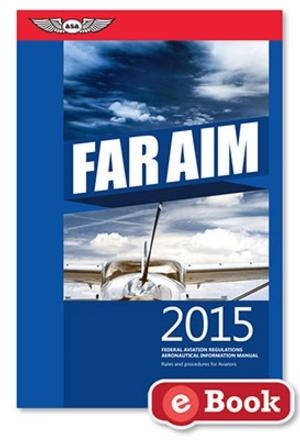
Most all new pilot students start their aviator life with a copy of the FAR/AIM book tucked in their training kit. It’s a thick book (About 21/2 pounds) which makes it look formable and unfriendly, and trying to actually read it from cover-to-cover could possibly cause brain damage.

The reason you do not start on page 1 and put it down on page 1,032 is because it is a reference manual, not a textbook. Trying to read it start to finish is like trying to read a phone book; there are lots of characters, but no plot. The way to use the FAR/AIM book is to look-up specific topics.

As the name implies, it is actually the combination of certain federal aviation regulations (FARs) and the FAA Aeronautical Information Manual (AIM). By the way,  the use of the term “FAR” is slang for the correct name for civil aviation regulations which is, Code of Federal Regulation, Title 14 (14 CFR). However, everyone (even the FAA) commonly uses the acronym, “FAR.” Even though the FAR/AIM book combines some FARs with the AIM, the FARs are one thing, and the AIM is something completely different.

Various commercial publishers print a book titled, FAR/AIM. Each publisher decides which FARs to include in their book and the AIM is nothing more than a reproduction of the FAA produced AIM.

The AIM could be referred to as a regulations user manual. Here is part of the description of the AIM that is found on the introduction page:

“This manual is designed to provide the aviation community with basic flight information and ATC procedures for use in the National Airspace System (NAS) of the United States…It also contains items of interest to pilots concerning health and medical facts, factors affecting flight safety, a pilot/controller glossary of terms used in the ATC System, and information on safety, accident, and hazard reporting.”

The AIM sort of gives us gives us the “how to” of regulation compliance. The FARs place limits on what we can do in the world of aviation. The AIM provides us with information and procedures, written in an easy to understand conversational format, that guide us into meeting the intent of regulation compliance.

The AIM is divided into 10 chapters, and these chapters are divided into sub-sections. It is paramount to use the index when using the AIM. It is easy to read and understand, but it is not written in a logical “storybook” fashion: it is a reference manual. Subjects are listed in the index by Chapter, Section, and Paragraph. Without using the index, it’s easy to get lost.

Regulations are written by lawyers for lawyers, but the AIM is written for all of us.

(Image from sporty’s.com)

FMI: www.faa.gov/regulations_policies/
 

Advertisement

More News

Aero-News: Quote of the Day (12.09.25)

“We respectfully call on the City of Mesa to: 1. Withdraw the landing fee proposal immediately 2. Engage with the aviation community before making decisions that impact safet>[...]

ANN's Daily Aero-Term (12.09.25): High Speed Taxiway

High Speed Taxiway A long radius taxiway designed and provided with lighting or marking to define the path of aircraft, traveling at high speed (up to 60 knots), from the runway ce>[...]

ANN's Daily Aero-Linx (12.09.25)

Aero Linx: International Federation of Airworthiness (IFA) IFA uniquely combines together all those with responsibility for policies, principles and practices concerned with the co>[...]

NTSB Final Report: Diamond Aircraft Ind Inc DA20C1 (A1); Robinson Helicopter R44

Controller’s Expectation That VW02 Would Have Departed Sooner Led To An Inadequate Scan And Loss Of Situational Awareness Analysis: A Robinson R-44 helicopter N744AF, VW02 (V>[...]

ANN FAQ: Q&A 101

A Few Questions AND Answers To Help You Get MORE Out of ANN! 1) I forgot my password. How do I find it? 1) Easy... click here and give us your e-mail address--we'll send it to you >[...]

blog comments powered by Disqus



Advertisement

Advertisement

Podcasts

Advertisement

© 2007 - 2025 Web Development & Design by Pauli Systems, LC

