Mon, Sep 12, 2011
SDO Greatly Increases Accuracy Of Radiation Measurement From
Solar Activity
NASA's Solar Dynamics Observatory, or SDO, has provided
scientists new information about solar flares indicating an
increase in strength and longevity that is more than previously
thought. Solar flares are intense bursts of radiation from the
release of magnetic energy associated with sunspots. They are the
solar system's largest explosive events and are seen as bright
areas on the sun. Their energy can reach Earth's atmosphere and
affect operations of Earth-orbiting communication and navigation
satellites.
NASA Image Of The Sun
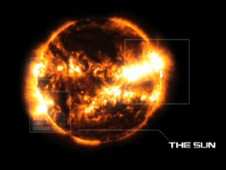
Using SDO's Extreme ultraviolet Variability Experiment (EVE)
instrument, scientists have observed that radiation from solar
flares continue for up to five hours beyond the main phase. The new
data also show the total energy from this extended phase of the
solar flare's peak sometimes has more energy than the initial
event. "Previous observations considered a few seconds or minutes
to be the normal part of the flare process," said Lika
Guhathakurta, lead program scientist for NASA's Living with a Star
Program at the agency's Headquarters in Washington. "This new data
will increase our understanding of flare physics and the
consequences in near-Earth space where many scientific and
commercial satellites reside."
On Nov. 3, 2010, SDO observed a solar flare. Scientists working
on the project say that if they had only measured the effects of
the flare as it initially happened, they would have underestimated
the amount of energy shooting into Earth's atmosphere by 70
percent. SDO's new observations provide a much more accurate
estimation of the total energy solar flares put into Earth's
environment. "For decades, our standard for flares has been to
watch the X-rays as they happen and see when they peak," said Tom
Woods, a space scientist at the University of Colorado in Boulder
and principal author on a paper in Wednesday's online edition of
Astrophysical Journal. "But we were seeing peaks that didn't
correspond to the X-rays."

During the course of a year, the team used EVE to map each
wavelength of light as it strengthened, peaked, and diminished over
time. EVE records data every 10 seconds and has observed many
flares. Previous instruments only measured every 90 minutes or
didn't look at all wavelengths simultaneously as SDO can.
To compliment the EVE graphical data, scientists used images
from another SDO instrument, the Advanced Imaging Assembly (AIA).
Analysis of these images showed the main flare eruption and its
extended phase in the form of magnetic field lines called coronal
loops that appeared far above the original eruption site. These
extra loops were longer and became brighter later than the loops
from the main flare and also were physically set apart from those
of the main flare.
Because this previously unrealized extra source of energy from
flares also is impacting Earth's atmosphere, Woods and his
colleagues are studying how the late phase flares can influence
space weather. Space weather caused by solar flares can affect
communication and navigation systems, satellite drag and the decay
of orbital debris.
More News
“We respectfully call on the City of Mesa to: 1. Withdraw the landing fee proposal immediately 2. Engage with the aviation community before making decisions that impact safet>[...]
High Speed Taxiway A long radius taxiway designed and provided with lighting or marking to define the path of aircraft, traveling at high speed (up to 60 knots), from the runway ce>[...]
Aero Linx: International Federation of Airworthiness (IFA) IFA uniquely combines together all those with responsibility for policies, principles and practices concerned with the co>[...]
Controller’s Expectation That VW02 Would Have Departed Sooner Led To An Inadequate Scan And Loss Of Situational Awareness Analysis: A Robinson R-44 helicopter N744AF, VW02 (V>[...]
A Few Questions AND Answers To Help You Get MORE Out of ANN! 1) I forgot my password. How do I find it? 1) Easy... click here and give us your e-mail address--we'll send it to you >[...]



 Aero-News: Quote of the Day (12.09.25)


 See All