

NTSB Issues Safety Alert For Piston Twin Pilots | Aero-News Network
Aero-News Network
RSS icon RSS feed
podcast icon MP3 podcast
Subscribe Aero-News e-mail Newsletter Subscribe

Airborne Unlimited -- Most Recent Daily Episodes

Episode Date

Airborne-Monday

Airborne-Tuesday

Airborne-Wednesday Airborne-Thursday

Airborne-Friday

Airborne On YouTube

Airborne-Unlimited-12.08.25

AirborneNextGen-
12.09.25

Airborne-Unlimited-12.10.25

Airborne-FltTraining-12.04.25

AirborneUnlimited-12.05.25

AFE 2025 LIVE MOSAIC Town Hall (Archived): www.airborne-live.net

Wed, Sep 11, 2024

NTSB Issues Safety Alert For Piston Twin Pilots

Gap In Training And Awareness For Partial Engine Failures

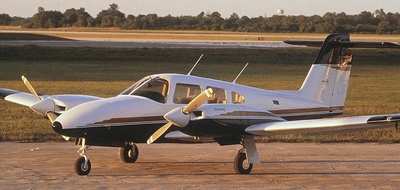
The NTSB recently issued a Safety Alert for pilots of piston twin-engine aircraft that identifies an apparent gap in training and awareness for situations when there is a partial power loss in one engine. Current training primarily addresses only total engine failures.

The agency notes that partial power loss is often mismanaged, accompanied by a higher probability of loss of control. The problem is that manually feathering props are equipped with start locks to prevent the blades from feathering during a normal shutdown procedure. This ensures that the next startup is made easier with the prop blades at a low pitch blade angle.

The start lock disengages when the prop is spinning above a certain rpm. However, if the propeller drops below the critical rpm during flight, such as during a partial power loss, the start lock can re-engage and prevent the pilot from feathering the prop, leading to a dangerous increase in drag with a subsequent potential loss of control. The only way to disengage the lock is to increase rpm which may not be possible with a partial loss of engine power.

The specific start lock engagement speed varies among various propeller makes and models, so the NTSB Safety Alert urges pilots to become familiar with the start lock engagement speed for their particular propeller and to train and practice partial power losses to know when to feather the prop before the rpm drops below that speed.

The Safety Alert states: “It is imperative, therefore, to feather the propeller before the rpm decreases below the start lock engagement speed. Delayed propeller feathering in partial loss of engine power scenarios can dangerously result in drag, compromising control and safety."

Read the full Safety Alert at the link below.

FMI:  www.ntsb.gov/

Advertisement

More News

ANN's Daily Aero-Term (12.08.25): Decision Altitude (DA)

Decision Altitude (DA) A specified altitude (mean sea level (MSL)) on an instrument approach procedure (ILS, GLS, vertically guided RNAV) at which the pilot must decide whether to >[...]

ANN's Daily Aero-Linx (12.08.25)

Aero Linx: T-34 Association, Inc. The T-34 Association was formed in July 1975 so that individuals purchasing then military surplus T-34As had an organization which would provide s>[...]

NTSB Final Report: Piper PA-31T3

As He Released The Brakes To Begin Taxiing, The Brake Pedals Went To The Floor With No Braking Action Analysis: The pilot reported that during engine start up, he applied the brake>[...]

Aero-News: Quote of the Day (12.08.25)

“Legislation like the Mental Health in Aviation Act is still imperative to hold the FAA accountable for the changes they clearly acknowledge need to be made... We cannot wait>[...]

Airborne-Flight Training 12.04.25: Ldg Fee Danger, Av Mental Health, PC-7 MKX

Also: IAE Acquires Diamond Trainers, Army Drones, FedEx Pilots Warning, DA62 MPP To Dresden Tech Uni The danger to the flight training industry and our future pilots is clear. Dona>[...]

blog comments powered by Disqus



Advertisement

Advertisement

Podcasts

Advertisement

© 2007 - 2025 Web Development & Design by Pauli Systems, LC

