
Airbus-Built ACLS Life Support Rack Is Ready For Launch From Tanegashima | Aero-News Network
Aero-News Network
RSS icon RSS feed
podcast icon MP3 podcast
Subscribe Aero-News e-mail Newsletter Subscribe

Airborne Unlimited -- Most Recent Daily Episodes

Episode Date

Airborne-Monday

Airborne-Tuesday

Airborne-Wednesday Airborne-Thursday

Airborne-Friday

Airborne On YouTube

Airborne-Unlimited-12.08.25

AirborneNextGen-
12.02.25

Airborne-Unlimited-12.03.25

Airborne-FltTraining-12.04.25

AirborneUnlimited-12.05.25

AFE 2025 LIVE MOSAIC Town Hall (Archived): www.airborne-live.net

Mon, Sep 10, 2018

Airbus-Built ACLS Life Support Rack Is Ready For Launch From Tanegashima

Alexander Gerst To Install ESA´s New Technology Demonstrator On The ISS

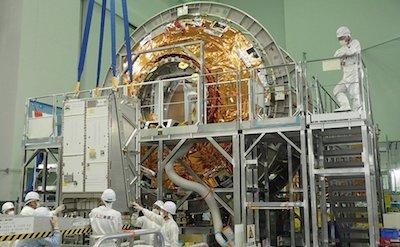
Airbus is sending a new Life Support Rack to the International Space Station (ISS). The rack also known as Advanced Closed Loop System (ACLS) has been developed by Airbus for the ESA as a technology demonstrator, which will purify air and produce oxygen for the ISS.

The Life Support Rack is stored in the pressurized part of the Japanese HTV-7, an unmanned cargo spacecraft to resupply the ISS, which is currently set to launch from Tanegashima Space Center on 11 September 2018. It will be installed into the Destiny Module (U.S. Laboratory) by ESA astronaut and ISS commander Alexander Gerst on 2 November 2018. Its technology is a critical step forward towards a closed loop life support system, necessary for human spaceflight beyond low Earth orbit.

Air on the ISS has a higher carbon dioxide content than on Earth, in the order of 0.4 percent. ACLS will provide additional capacity to the existing ISS life support system to remove carbon dioxide from the cabin air. This is performed by two components: CO2 adsorption using Astrine (a solid amine resin), and use of a Sabatier reactor (using hydrogen to convert carbon dioxide into methane and water).

The third component of ESA´s new Rack is its electrolyser, which produces oxygen and hydrogen from water. The oxygen produced is used to replenish the cabin air, and the hydrogen is consumed by the Sabatier reactor.

A newly formed ACLS operations team (OPS), based at Airbus in Friedrichshafen, Germany, will operate the ACLS throughout its mission. ACLS OPS is part of the ISS’s ground network, and works directly with the ESA Columbus Control Center in Oberpfaffenhofen, Germany.

Following installation, the ACLS OPS team will commence a six week commissioning phase to check the new facility. Successful commissioning will be followed by operations on the ISS until the end of 2019, with the ACLS providing additional carbon dioxide removal and oxygen generation capabilities to the astronauts onboard.

(Image provided with Airbus news release)

FMI: www.airbus.com

Advertisement

More News

NTSB Final Report: Patriot Aircraft LLC CX1900A

After Draining Both Wing Fuel Tanks, A Significant Amount Of Water Was Observed In The Right Wing Fuel Tank Analysis: The pilot, who was also the owner of the experimental amateur->[...]

Aero-News: Quote of the Day (12.06.25)

“Airbus apologises for any challenges and delays caused to passengers and airlines by this event. The Company thanks its customers, the authorities, its employees and all rel>[...]

ANN's Daily Aero-Term (12.06.25): High Speed Taxiway

High Speed Taxiway A long radius taxiway designed and provided with lighting or marking to define the path of aircraft, traveling at high speed (up to 60 knots), from the runway ce>[...]

ANN's Daily Aero-Linx (12.06.25)

Aero Linx: Taylorcraft Foundation, Inc. The Taylorcraft Foundation is exclusively organized for charitable, educational & scientific activities and will preserve the history an>[...]

Airborne-NextGen 12.02.25: Honda eVTOL, Arctus High-Alt UAS, Samson Patent

Also: USAF Reaper Accident, Baikonur Damage, Horizon eVTOL IFR/FIKI, New Glenn Update Honda has outlined its clearest timeline yet for its entry into the world of electric vertical>[...]

blog comments powered by Disqus



Advertisement

Advertisement

Podcasts

Advertisement

© 2007 - 2025 Web Development & Design by Pauli Systems, LC

