
NASA To Launch Parachute Test Off Virginia Coast March 27 | Aero-News Network
Aero-News Network
RSS icon RSS feed
podcast icon MP3 podcast
Subscribe Aero-News e-mail Newsletter Subscribe

Airborne Unlimited -- Most Recent Daily Episodes

Episode Date

Airborne-Monday

Airborne-Tuesday

Airborne-Wednesday Airborne-Thursday

Airborne-Friday

Airborne On YouTube

Airborne-SpecialEpisode-12.15.25

AirborneNextGen-
12.16.25

Airborne-Unlimited-12.10.25

Airborne-AffordableFlyers-12.11.25

AirborneUnlimited-12.12.25

AFE 2025 LIVE MOSAIC Town Hall (Archived): www.airborne-live.net

Thu, Mar 22, 2018

NASA To Launch Parachute Test Off Virginia Coast March 27

ASPIRE System To Be Launched On March 27

NASA will test a parachute for possible future missions to Mars from NASA’s Wallops Flight Facility in Virginia on Tuesday, March 27. Live coverage of the test is scheduled to begin at 6:15 a.m. EDT on the Wallops Ustream site.

The launch window for the 58-foot-tall Terrier-Black Brant IX suborbital sounding rocket is from 6:45 to 10:15 a.m. EDT. Backup launch days are March 28 to April 10.

The NASA Visitor Center at Wallops will open at 6 a.m. on launch day for viewing the flight. The rocket launch is expected to be only seen from the Wallops area.

The rocket will carry the Advanced Supersonic Parachute Inflation Research Experiment (ASPIRE) from NASA’s Jet Propulsion Laboratory (JPL) in Pasadena, CA. The payload carrying the test parachute is expected to reach an altitude of 32 miles approximately two minutes into the flight. The payload will splash-down in the Atlantic Ocean 40 miles from Wallops Island and will be recovered and returned to Wallops for data retrieval and inspection.

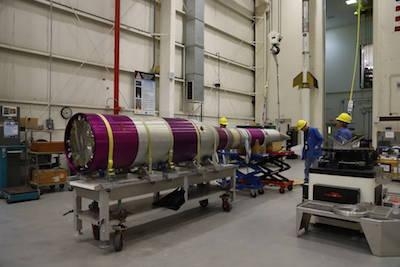
The payload is a bullet-nosed, cylindrical structure holding a supersonic parachute, the parachute's deployment mechanism, and the test's high-definition instrumentation, including cameras, to record data.

ASPIRE is managed by JPL, with support from NASA's Langley Research Center in Hampton, Virginia, and Ames Research Center in Silicon Valley, California, for the agency’s Science Mission Directorate in Washington.  

NASA's Sounding Rocket Program is based at Wallops. Orbital ATK in Dulles, Virginia, provides mission planning, engineering services and field operations through the NASA Sounding Rocket Operations Contract. NASA's Heliophysics Division in Washington manages the sounding rocket program for the agency.

(Image provided with NASA news release)

FMI: www.nasa.gov

Advertisement

More News

ANN's Daily Aero-Term (12.14.25): Local Airport Advisory (LAA)

Local Airport Advisory (LAA) A service available only in Alaska and provided by facilities that are located on the landing airport, have a discrete ground-to-air communication freq>[...]

Airborne 12.08.25: Samaritan’s Purse Hijack, FAA Med Relief, China Rocket Fail

Also: Cosmonaut Kicked Out, Airbus Scales Back, AF Silver Star, Russian A-60 Clobbered A Samaritan’s Purse humanitarian flight was hijacked on Tuesday, December 2, while atte>[...]

ANN's Daily Aero-Linx (12.15.25)

Aero Linx: Michigan Helicopter Association (MHA) The Michigan Helicopter Association (MHA) exists to bring together people who share an interest in helicopters, including private, >[...]

Airborne 12.10.25: New Gulfstream, ATC Integrator, Outrageous FFZ User Fees

Also: Airbus Acquisition, USCG Helo Sniper, Remember Pearl Harbor, New Thunderbird 1 Gulfstream’s newest addition to its next-gen lineup, the super-midsize G300, is officiall>[...]

Airborne-NextGen 12.09.25: Amazon Crash, China Rocket Accident, UAV Black Hawk

Also: Electra Goes Military, Miami Air Taxi, Hypersonics Lab, MagniX HeliStrom Amazon’s Prime Air drones are back in the spotlight after one of its newest MK30 delivery drone>[...]

blog comments powered by Disqus



Advertisement

Advertisement

Podcasts

Advertisement

© 2007 - 2025 Web Development & Design by Pauli Systems, LC

