
Raytheon Miniaturized Radio System Onboard Indian Lunar Probe | Aero-News Network
Aero-News Network
RSS icon RSS feed
podcast icon MP3 podcast
Subscribe Aero-News e-mail Newsletter Subscribe

Airborne Unlimited -- Most Recent Daily Episodes

Episode Date

Airborne-Monday

Airborne-Tuesday

Airborne-Wednesday Airborne-Thursday

Airborne-Friday

Airborne On YouTube

Airborne-Unlimited-12.22.25

AirborneNextGen-
12.23.25

Airborne-Unlimited-12.10.25

Airborne-FltTraining-12.18.25

AirborneUnlimited-12.19.25

AFE 2025 LIVE MOSAIC Town Hall (Archived): www.airborne-live.net

Fri, Oct 24, 2008

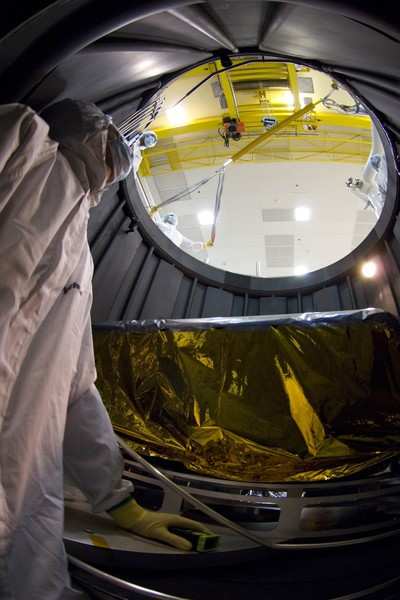
Raytheon Miniaturized Radio System Onboard Indian Lunar Probe

Chandrayaan-1 To Search For Ice On Moon

Sensing technology developed by Raytheon will help to determine whether the polar regions of the moon contain ice.

The company's Forerunner miniaturized-radio frequency system was delivered by Johns Hopkins University Applied Physics Laboratory to the Indian Space Research Organization in March 2008, integrated onto the nation's Chandrayaan-1 spacecraft, and launched into orbit October 22 from the Satish Dhawan Space Center in Sriharikota, India.

Under contract to the US Navy, Raytheon provided the antenna, transmitter, analog receiver and software for the Forerunner mini-RF system. The company also supplied system engineering and integration and test support.

Raytheon provided similar modules and support under the same contract for NASA's Lunar Reconnaissance Orbiter program. The LRO spacecraft is currently undergoing environmental testing and is scheduled for launch in March 2009.

"The responsive space concept holds great promise for many kinds of future missions, and Raytheon is proud to extend its leading role in that future with the mini-RF payloads," said Brian Arnold, vice president for Space Systems. "We're excited to be applying the lessons from our experience in operationally responsive space to these important lunar exploration projects."

Raytheon's work on the Forerunner program takes advantage of the company's prior experience in support of the Department of Defense's operationally responsive space initiative, which calls for smaller, less expensive satellites that can provide scientific or tactical information on an as-needed basis. Because of its low development cost and miniaturization, the mini-RF technology provides a wealth of sensing capabilities in a relatively inexpensive and easily adapted platform.

FMI: www.raytheon.com, www.chandrayaan-i.com/index.html

Advertisement

More News

Classic Aero-TV: In Praise of Alabama’s Patriot Aircraft USA

From 2023 (YouTube Edition): "Ain’t Your Daddy’s Super Cub”—Don Wade Co-owned by Don and Ron Wade—the former of Don’s Dream Machines, a storied >[...]

NTSB Final Report: Cirrus Design Corp SR22

Pilot-Rated Passenger Reported That The Pilot Did Not Adequately “Round Out” The Landing Flare And The Airplane Bounced And Yawed To The Right Analysis: The pilot state>[...]

ANN's Daily Aero-Term (12.21.25): Dead Reckoning

Dead Reckoning Dead reckoning, as applied to flying, is the navigation of an airplane solely by means of computations based on airspeed, course, heading, wind direction, and speed,>[...]

ANN's Daily Aero-Linx (12.21.25)

Aero Linx: Lake Amphibian Club This website is created and sponsored by the Lake Amphibian Club, to help spread the word about these wonderful, versatile amphibians that can land j>[...]

Aero-News: Quote of the Day (12.21.25)

“I am deeply honored to be sworn in as NASA administrator. NASA’s mission is as imperative and urgent as ever — to push the boundaries of human exploration, ignit>[...]

blog comments powered by Disqus



Advertisement

Advertisement

Podcasts

Advertisement

© 2007 - 2025 Web Development & Design by Pauli Systems, LC

