Agency Calling The Effort Its 'Most Complex Airborne Science Campaign Of The Year'
NASA aircraft will be conducting flights over the southern United States this summer to investigate how air pollution and natural emissions, which are pushed high into the atmosphere by large storms, affect atmospheric composition and climate. NASA will pursue what it is calling its most complex airborne science campaign of the year from Houston's Ellington Field, which is operated by the agency's Johnson Space Center, beginning Aug. 7 and continuing through September. The field campaign draws together coordinated observations from NASA satellites, aircraft and an array of ground sites.
More than 250 scientists, engineers, and flight personnel are participating in the Studies of Emissions, Atmospheric Composition, Clouds and Climate Coupling by Regional Surveys (SEAC4RS) campaign. The project is sponsored by the Earth Science Division in the Science Mission Directorate at NASA Headquarters in Washington. Brian Toon of the Department of Atmospheric and Oceanic Sciences at the University of Colorado, Boulder, is SEAC4RS lead scientist.
Aircraft and sensors will probe the atmosphere from top to bottom at the critical time of year when weather systems are strong enough and regional air pollution and natural emissions are prolific enough to pump gases and particles high into the atmosphere. The result is potentially global consequences for Earth's atmosphere and climate.
"In summertime across the United States, emissions from large seasonal fires, metropolitan areas, and vegetation are moved upward by thunderstorms and the North American Monsoon," Toon said. "When these chemicals get into the stratosphere they can affect the whole Earth. They also may influence how thunderstorms behave. With SEAC4RS we hope to better understand how all these things interact."
SEAC4RS will provide new insights into the effects of the gases and tiny aerosol particles in the atmosphere. The mission is targeting two major regional sources of summertime emissions: intense smoke from forest fires in the U.S. West and natural emissions of isoprene, a carbon compound, from forests in the Southeast.
Forest fire smoke can change the properties of clouds. The particles in the smoke can reflect and absorb incoming solar energy, potentially producing a net cooling at the ground and a warming of the atmosphere. The addition of large amounts of chemicals, such as isoprene, can alter the chemical balance of the atmosphere. Some of these chemicals can damage Earth's protective ozone layer.
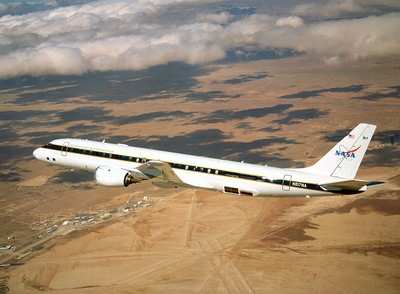
The mission will use a number of scientific instruments in orbit, in the air, and on the ground to paint a detailed picture of these intertwined atmospheric processes. As a fleet of formation-flying satellites known as NASA's A-Train passes over the region every day, sensors will detect different features of the scene below. NASA's ER-2 high-altitude aircraft will fly into the stratosphere to the edge of space while NASA's DC-8 aircraft (pictured) will sample the atmosphere below it. A third aircraft from SPEC Inc., of Boulder, CO, will measure cloud properties.
One benefit of this thorough examination of the region's atmosphere will be more accurate satellite data. "By using aircraft to collect data from inside the atmosphere, we can compare those measurements with what our satellites see and improve the quality of the data from space," said Hal Maring of the Earth Science Division at NASA Headquarters.
(Images provided by NASA)



 NTSB Final Report: Patriot Aircraft LLC CX1900A


 See All