
NASA Downplays Threat Of More Debris Heading Towards ISS | Aero-News Network
Aero-News Network
RSS icon RSS feed
podcast icon MP3 podcast
Subscribe Aero-News e-mail Newsletter Subscribe

Airborne Unlimited -- Most Recent Daily Episodes

Episode Date

Airborne-Monday

Airborne-Tuesday

Airborne-Wednesday Airborne-Thursday

Airborne-Friday

Airborne On YouTube

Airborne-SpecialEpisode-12.15.25

AirborneNextGen-
12.16.25

Airborne-Unlimited-12.10.25

Airborne-AffordableFlyers-12.11.25

AirborneUnlimited-12.12.25

AFE 2025 LIVE MOSAIC Town Hall (Archived): www.airborne-live.net

Tue, Mar 17, 2009

NASA Downplays Threat Of More Debris Heading Towards ISS

Discovery Scheduled To Dock At Station Tuesday

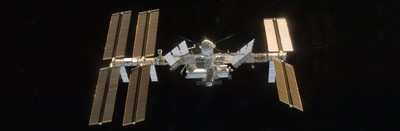
After being caught off guard last week, officials at NASA kept close track Monday of yet another chunk of space trash that threatened to come uncomfortably close to the International Space Station, as the shuttle Discovery maneuvered to a Tuesday rendezvous with the orbital outpost.

The Associated Press reports the four-inch-long chunk of debris -- from a Soviet-era satellite that broke apart in 1981 -- was in danger of coming within a half-mile of the ISS. The object's erratic orbital track makes it difficult for scientists to pin down an accurate track.

Further complicating matters was Sunday's launch of Discovery. As ANN reported, the shuttle is now inbound to the station to deliver the final set of solar array panels needed to bring the ISS up to full power, in order to support a full crew of six.

NASA feared it would need to alter the station's orbit, should the object track closer than engineers were comfortable with... but NASA announced late Monday the "debris avoidance maneuver" wouldn't be necessary.

Scientists say the orbital debris was from the old Kosmos 1275 military satellite... which broke up under mysterious circumstances soon after launch nearly 28 years ago. There's a chance that accident was caused by collision with orbital debris, though Russian scientists maintain a battery onboard the satellite exploded.

In related news, on Monday the seven-member crew of Discovery's STS-119 mission spent their first full day in orbit. As has become routine for shuttle missions following the February 2003 loss of Columbia on reentry, the crew conducted detailed inspections of the orbiter's nose and forward wing sections, using laser scanners to look for damage incurred to the fragile heat shield during launch.

A preliminary inspection showed no evidence of damage, and video recorded during launch showed no significant incidences of insulating foam from the external tank striking the delicate underside of the orbiter.

FMI: www.nasa.gov/station

Advertisement

More News

ANN's Daily Aero-Term (12.14.25): Local Airport Advisory (LAA)

Local Airport Advisory (LAA) A service available only in Alaska and provided by facilities that are located on the landing airport, have a discrete ground-to-air communication freq>[...]

Airborne 12.08.25: Samaritan’s Purse Hijack, FAA Med Relief, China Rocket Fail

Also: Cosmonaut Kicked Out, Airbus Scales Back, AF Silver Star, Russian A-60 Clobbered A Samaritan’s Purse humanitarian flight was hijacked on Tuesday, December 2, while atte>[...]

ANN's Daily Aero-Linx (12.15.25)

Aero Linx: Michigan Helicopter Association (MHA) The Michigan Helicopter Association (MHA) exists to bring together people who share an interest in helicopters, including private, >[...]

Airborne 12.10.25: New Gulfstream, ATC Integrator, Outrageous FFZ User Fees

Also: Airbus Acquisition, USCG Helo Sniper, Remember Pearl Harbor, New Thunderbird 1 Gulfstream’s newest addition to its next-gen lineup, the super-midsize G300, is officiall>[...]

Airborne-NextGen 12.09.25: Amazon Crash, China Rocket Accident, UAV Black Hawk

Also: Electra Goes Military, Miami Air Taxi, Hypersonics Lab, MagniX HeliStrom Amazon’s Prime Air drones are back in the spotlight after one of its newest MK30 delivery drone>[...]

blog comments powered by Disqus



Advertisement

Advertisement

Podcasts

Advertisement

© 2007 - 2025 Web Development & Design by Pauli Systems, LC

