
US Navy Recovers Downed MH-60S Helicopter from Record Depth | Aero-News Network
Aero-News Network
RSS icon RSS feed
podcast icon MP3 podcast
Subscribe Aero-News e-mail Newsletter Subscribe

Airborne Unlimited -- Most Recent Daily Episodes

Episode Date

Airborne-Monday

Airborne-Tuesday

Airborne-Wednesday Airborne-Thursday

Airborne-Friday

Airborne On YouTube

Airborne-Unlimited-12.22.25

AirborneNextGen-
12.23.25

Airborne-Unlimited-12.10.25

Airborne-FltTraining-12.18.25

AirborneUnlimited-12.19.25

AFE 2025 LIVE MOSAIC Town Hall (Archived): www.airborne-live.net

Wed, Mar 24, 2021

US Navy Recovers Downed MH-60S Helicopter from Record Depth

Air Crew Was Able To Escape The MH-60S Before It Sank And No Lives Were Lost In The Accident

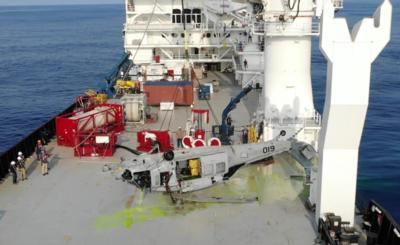
NAVSEA’s Supervisor of Salvage and Diving (SUPSALV) recovered a downed Navy MH-60S helicopter from a depth of 19,075 feet off the coast of Okinawa, Japan Thursday, March 22nd.

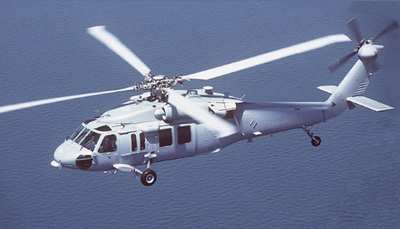
The helicopter, a twin-engine Sikorsky Seahawk, crashed into the Pacific Ocean last year while operating from the amphibious command ship USS Blue Ridge (LCC-19). The air crew was able to escape the MH-60S before it sank and no lives were lost in the accident.

Responding to a U.S. Pacific Command Fleet request, SUPSALV located and documented the wreckage using side-scan sonar and photographs of the helicopter as it lay on the ocean floor during North Pacific operations last spring.

SUPSALV returned to the site this month at the request of the Navy Safety Center with CURV 21, a deep-water, remotely operated vehicle with the ability to meet deep ocean salvage requirements to a maximum depth of 20,000 feet.

The SUPSALV team met the contracted salvage vessel in Guam, completed mobilization of CURV and its deep-lift take-up reel, and departed for the five-day transit. Arriving on the crash site March 17, the team began recovery operations. Pulled from its depth of 19,075 FSW, the MH-60S’s recovery broke SUPSALV’s own world depth record for aircraft recovery.

The salvage vessel will proceed to Fleet Activities Yokosuka where the MH-60S will be offloaded for transport back to the United States.

“As a whole, this operation was fast-paced and entirely successful,” said Bryan Blake, SUPSALV’s Deep Ocean Program Manager. “Our efforts validated the Navy’s deep ocean search and recovery requirements. The capability to recover the airframe and make it available to determine the cause of the accident is a huge plus helping to ensure Naval Aviation safety."

FMI: www.navy.mil

Advertisement

More News

Classic Aero-TV: In Praise of Alabama’s Patriot Aircraft USA

From 2023 (YouTube Edition): "Ain’t Your Daddy’s Super Cub”—Don Wade Co-owned by Don and Ron Wade—the former of Don’s Dream Machines, a storied >[...]

NTSB Final Report: Cirrus Design Corp SR22

Pilot-Rated Passenger Reported That The Pilot Did Not Adequately “Round Out” The Landing Flare And The Airplane Bounced And Yawed To The Right Analysis: The pilot state>[...]

ANN's Daily Aero-Term (12.21.25): Dead Reckoning

Dead Reckoning Dead reckoning, as applied to flying, is the navigation of an airplane solely by means of computations based on airspeed, course, heading, wind direction, and speed,>[...]

ANN's Daily Aero-Linx (12.21.25)

Aero Linx: Lake Amphibian Club This website is created and sponsored by the Lake Amphibian Club, to help spread the word about these wonderful, versatile amphibians that can land j>[...]

Aero-News: Quote of the Day (12.21.25)

“I am deeply honored to be sworn in as NASA administrator. NASA’s mission is as imperative and urgent as ever — to push the boundaries of human exploration, ignit>[...]

blog comments powered by Disqus



Advertisement

Advertisement

Podcasts

Advertisement

© 2007 - 2025 Web Development & Design by Pauli Systems, LC

