Impact Was Visible With Amateur Telescopes
 NASA's Lunar Crater Observation and Sensing Satellite, or
LCROSS, created twin impacts on the moon's surface early Friday in
a search for water ice. Scientists will analyze data from the
spacecraft's instruments to assess whether water ice is
present.
NASA's Lunar Crater Observation and Sensing Satellite, or
LCROSS, created twin impacts on the moon's surface early Friday in
a search for water ice. Scientists will analyze data from the
spacecraft's instruments to assess whether water ice is
present.
The satellite traveled 5.6 million miles during an historic
113-day mission that ended in the Cabeus crater, a permanently
shadowed region near the moon's south pole. The spacecraft was
launched June 18 as a companion mission to the Lunar Reconnaissance
Orbiter from NASA's Kennedy Space Center in Florida.
"The LCROSS science instruments worked exceedingly well and
returned a wealth of data that will greatly improve our
understanding of our closest celestial neighbor," said Anthony
Colaprete, LCROSS principal investigator and project scientist at
NASA's Ames Research Center in Moffett Field, Calif. "The team is
excited to dive into data."
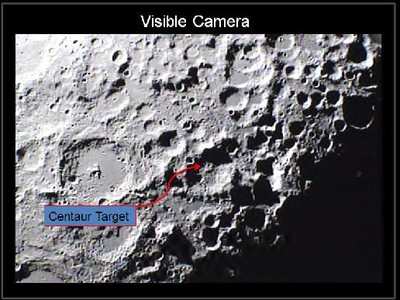
In preparation for impact, LCROSS and its spent Centaur upper
stage rocket separated about 54,000 miles above the surface of the
moon on Thursday at approximately 6:50 p.m. PDT.
NASA Image
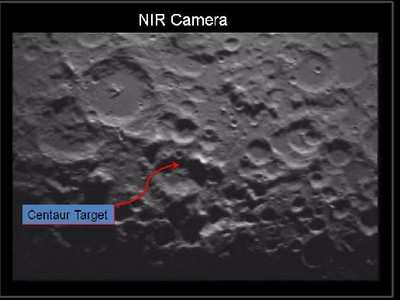
Moving at a speed of more than 1.5 miles per second, the Centaur
hit the lunar surface shortly after 4:31 a.m. Oct. 9, creating an
impact that instruments aboard LCROSS observed for approximately
four minutes. LCROSS then impacted the surface at approximately
4:36 a.m.
"This is a great day for science and exploration," said Doug
Cooke, associate administrator for the Exploration Systems Mission
Directorate at NASA Headquarters in Washington. "The LCROSS data
should prove to be an impressive addition to the tremendous leaps
in knowledge about the moon that have been achieved in recent
weeks. I want to congratulate the LCROSS team for their tremendous
achievement in development of this low cost spacecraft and for
their perseverance through a number of difficult technical and
operational challenges."?
Other observatories reported capturing both impacts. The data
will be shared with the LCROSS science team for analysis. The
LCROSS team expects it to take several weeks of analysis before it
can make a definitive assessment of the presence or absence of
water ice.
"I am very proud of the success of this LCROSS mission team,"
said Daniel Andrews, LCROSS project manager at Ames. "Whenever this
team would hit a roadblock, it conceived a clever work-around
allowing us to push forward with a successful mission."
The images and video collected by the amateur astronomer
community and the public also will be used to enhance our knowledge
about the moon.
NASA Image
"One of the early goals of the mission was to get as many people
to look at the LCROSS impacts in as many ways possible, and we
succeeded," said Jennifer Heldmann, Ames' coordinator of the LCROSS
observation campaign. "The amount of corroborated information that
can be pulled out of this one event is fascinating."
"It has been an incredible journey since LCROSS was selected in
April 2006," said Andrews. "The LCROSS Project faced a very
ambitious schedule and an uncommonly small budget for a mission of
this size. LCROSS could be a model for how small robotic missions
are executed. This is truly big science on a small budget."



 NTSB Final Report: Patriot Aircraft LLC CX1900A


 See All