
Air Force: Drone Accident Rate At Civilian Airports 'Unacceptably High' | Aero-News Network
Aero-News Network
RSS icon RSS feed
podcast icon MP3 podcast
Subscribe Aero-News e-mail Newsletter Subscribe

Airborne Unlimited -- Most Recent Daily Episodes

Episode Date

Airborne-Monday

Airborne-Tuesday

Airborne-Wednesday Airborne-Thursday

Airborne-Friday

Airborne On YouTube

Airborne-Unlimited-12.08.25

AirborneNextGen-
12.09.25

Airborne-Unlimited-12.10.25

Airborne-FltTraining-12.04.25

AirborneUnlimited-12.05.25

AFE 2025 LIVE MOSAIC Town Hall (Archived): www.airborne-live.net

Wed, Dec 12, 2012

Air Force: Drone Accident Rate At Civilian Airports 'Unacceptably High'

Pilot Error, Software Issues, Mechanical Failures All Cited As Causes

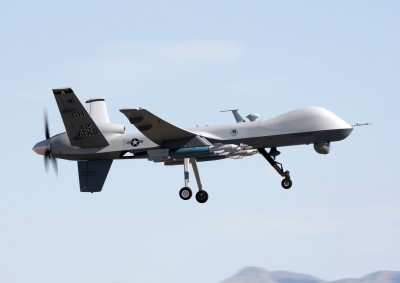
Internal Air Force investigation reports indicate that the service is losing drones at an unacceptably high rate at civilian airports similar to an accident which occurred in the Seychelles in April. In that accident, an inexperienced operator flying an MQ-9 Reaper (similar aircraft pictured in USAF photo) launched the aircraft without permission, mishandled the flight controls, and wound up crashing it onto the runway without its landing gear deployed. It skidded into the ocean off the end of the runway.

In an enterprise report in the Washington Post, documents obtained through a Freedom of Information Act request show that there have been numerous accidents involving military UAVs at civilian airports over the past two years. The reports consistently cite pilot error, software issues, mechanical failures, and inadequate coordination with civilian air traffic controllers in the accidents.

The paper reports that there have been numerous instances of Predator and Reaper accidents occurring near non-military airports, sometimes with civilian contractors operating the aircraft. Some have been under the auspices of the CIA, which is basing UAVs at a civilian airport in Ethiopia for missions over Somalia.

The accidents have not gone unnoticed by those expressing concerns about the FAA's plan to allow the operation of unmanned aircraft in the National Air Space (NAS). The Air Force says the accident rate is declining as the technology matures, and that the incident rate is now comparable to that of the service's fleet of F-16 fighter jets at a similar stage of development.

FMI: www.af.mil

Advertisement

More News

ANN's Daily Aero-Term (12.08.25): Decision Altitude (DA)

Decision Altitude (DA) A specified altitude (mean sea level (MSL)) on an instrument approach procedure (ILS, GLS, vertically guided RNAV) at which the pilot must decide whether to >[...]

ANN's Daily Aero-Linx (12.08.25)

Aero Linx: T-34 Association, Inc. The T-34 Association was formed in July 1975 so that individuals purchasing then military surplus T-34As had an organization which would provide s>[...]

NTSB Final Report: Piper PA-31T3

As He Released The Brakes To Begin Taxiing, The Brake Pedals Went To The Floor With No Braking Action Analysis: The pilot reported that during engine start up, he applied the brake>[...]

Aero-News: Quote of the Day (12.08.25)

“Legislation like the Mental Health in Aviation Act is still imperative to hold the FAA accountable for the changes they clearly acknowledge need to be made... We cannot wait>[...]

Airborne-Flight Training 12.04.25: Ldg Fee Danger, Av Mental Health, PC-7 MKX

Also: IAE Acquires Diamond Trainers, Army Drones, FedEx Pilots Warning, DA62 MPP To Dresden Tech Uni The danger to the flight training industry and our future pilots is clear. Dona>[...]

blog comments powered by Disqus



Advertisement

Advertisement

Podcasts

Advertisement

© 2007 - 2025 Web Development & Design by Pauli Systems, LC

