
NASA Completes First Series Of Ares Engine Tests | Aero-News Network
Aero-News Network
RSS icon RSS feed
podcast icon MP3 podcast
Subscribe Aero-News e-mail Newsletter Subscribe

Airborne Unlimited -- Most Recent Daily Episodes

Episode Date

Airborne-Monday

Airborne-Tuesday

Airborne-Wednesday Airborne-Thursday

Airborne-Friday

Airborne On YouTube

Airborne-Unlimited-12.08.25

AirborneNextGen-
12.02.25

Airborne-Unlimited-12.03.25

Airborne-FltTraining-12.04.25

AirborneUnlimited-12.05.25

AFE 2025 LIVE MOSAIC Town Hall (Archived): www.airborne-live.net

Sat, May 10, 2008

NASA Completes First Series Of Ares Engine Tests

Important Step Towards Development Of J-2X Motor

NASA engineers Thursday successfully completed the first series of tests in the early development of the J-2X engine that will power the upper stages of the Ares I and Ares V rockets, key components of NASA's Constellation Program. Ares I will launch the Orion spacecraft that will take astronauts to the International Space Station and then to the moon by 2020. The Ares V will carry cargo and components into orbit for trips to the moon and later to Mars.

NASA conducted nine tests of heritage J-2 engine components from December to May as part of a series designed to verify heritage J-2 performance data and explore performance boundaries.

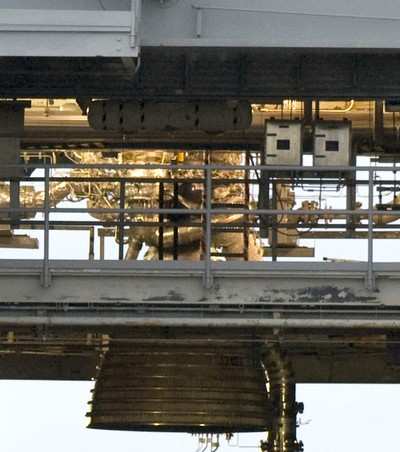
Engineers at NASA's Stennis Space Center near Bay St. Louis, MO, conducted the tests on a heritage J-2 "powerpack," which, in a fully assembled engine, pumps liquid hydrogen and liquid oxygen into the engine's main combustion chamber to produce thrust. The test hardware consisted of J-2 components used from the Apollo program in the1960s through the X-33 program of the 1990s.

"This series of tests is an important step in development of the J-2X engine," said Mike Kynard, manager of the upper stage engine for the Ares Projects at NASA's Marshall Space Flight Center in Huntsville, AL. "We started with a number of objectives and questions we needed answers to as we work to complete designs of the J-2X engine. The data we have gained will be invaluable as we continue the design process."

Data obtained from the tests will be used to refine the design of the J-2X pumps and other engine components to provide the additional performance required of this new engine. The J-2X engine is being designed to produce 294,000 pounds of thrust; the original J-2 -- used to launch the Saturn V moon rockets of the late-1960s and early-1970s -- produced 230,000 pounds of thrust.

The main objectives of the series were to resolve differences in heritage turbopump performance data and recent component-level tests, and investigate vibration and pressure drops through the turbopump inlet ducts. Tests in the series ran for durations up to 400 seconds and at power levels up to 274,000 pounds of thrust.

After the data from the test series has been reviewed and objectives met, Stennis will begin readying the test stand for the next series of tests, said Gary Benton, the J-2X project manager at Stennis.

FMI: www.nasa.gov

Advertisement

More News

NTSB Final Report: Patriot Aircraft LLC CX1900A

After Draining Both Wing Fuel Tanks, A Significant Amount Of Water Was Observed In The Right Wing Fuel Tank Analysis: The pilot, who was also the owner of the experimental amateur->[...]

Aero-News: Quote of the Day (12.06.25)

“Airbus apologises for any challenges and delays caused to passengers and airlines by this event. The Company thanks its customers, the authorities, its employees and all rel>[...]

ANN's Daily Aero-Term (12.06.25): High Speed Taxiway

High Speed Taxiway A long radius taxiway designed and provided with lighting or marking to define the path of aircraft, traveling at high speed (up to 60 knots), from the runway ce>[...]

ANN's Daily Aero-Linx (12.06.25)

Aero Linx: Taylorcraft Foundation, Inc. The Taylorcraft Foundation is exclusively organized for charitable, educational & scientific activities and will preserve the history an>[...]

Airborne-NextGen 12.02.25: Honda eVTOL, Arctus High-Alt UAS, Samson Patent

Also: USAF Reaper Accident, Baikonur Damage, Horizon eVTOL IFR/FIKI, New Glenn Update Honda has outlined its clearest timeline yet for its entry into the world of electric vertical>[...]

blog comments powered by Disqus



Advertisement

Advertisement

Podcasts

Advertisement

© 2007 - 2025 Web Development & Design by Pauli Systems, LC

