

Estes Brings A New Shepard Model To Market | Aero-News Network
Aero-News Network
RSS icon RSS feed
podcast icon MP3 podcast
Subscribe Aero-News e-mail Newsletter Subscribe

Airborne Unlimited -- Most Recent Daily Episodes

Episode Date

Airborne-Monday

Airborne-Tuesday

Airborne-Wednesday Airborne-Thursday

Airborne-Friday

Airborne On YouTube

Airborne-Unlimited-11.24.25

AirborneNextGen-
11.18.25

Airborne-Unlimited-11.19.25

Airborne-AffordableFlyers-11.20.25

AirborneUnlimited-11.21.25

LIVE MOSAIC Town Hall (Archived): www.airborne-live.net

Mon, Aug 30, 2021

Estes Brings A New Shepard Model To Market

The Model Rocket Flies 400ft, Deploys Capsule

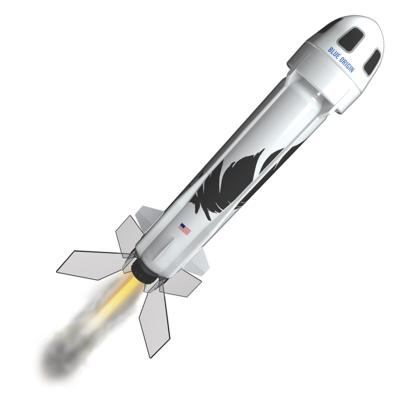
You can now launch your own version of the Blue Origin New Shepard with the Estes New Shepard model rocket.

The Estes New Shepard is a 1/66th scale model of the Blue Origin New Shepard. 

The model rocket flies to altitude on a C6-3 or C6-5 with capabilities of up to 400ft. After deploying a capsule, it falls back down to Earth with a large parachute. 

You can fly and deploy this model as many times as you like, and it will be made available on the first of November.

The Estes New Shepard aims to provide the excitement of launch and feeling of exploring a new frontier to everyone. The collaboration is the first in a series between Estes and Blue Origins Club for The Future, which is a non-profit educational foundation.

"The Estes and Club for the Future collaboration is the next exciting step in Estes's long legacy of supporting STEM education and the Estes New Shepard is the perfect vehicle to inspire future generations," said Mallory Langford, president of Estes Industries.

The Blue Origin New Shepard is 59ft tall. The rocket fires its BE-3 engine for 110 seconds producing 110,000 lbs of thrust. 

Specifications of the Estes New Shepard are as follows: With a projected max altitude of 400 feet and a 15 in parachute as a recovery system, the Estes is 10.34 inches long,  1.78 inches in diameter and weighs 4 oz.

The Estes takes about ten minutes to assemble and the fin materials are made of plastic. The launch system uses a Porta-Pad II and Electron Beam Launch Controllers, and additionally, four AA batteries are required for use.

FMI: www.estesrockets.com

Advertisement

More News

Classic Aero-TV: Extra; the Airplane, the Man, and His Grand DeLand Plan

From 2023 (YouTube Edition): Germany’s Best by Way of Florida Established in 1980 by German aerobatic pilot Walter Extra as a means by which to design and develop his own air>[...]

ANN FAQ: Follow Us On Instagram!

Get The Latest in Aviation News NOW on Instagram Are you on Instagram yet? It's been around for a few years, quietly picking up traction mostly thanks to everybody's new obsession >[...]

Aero-News: Quote of the Day (11.27.25)

“Achieving PMA for the S-1200 Series magnetos is another step in expanding our commitment to providing the aviation community with the most trusted and durable ‘firewal>[...]

ANN's Daily Aero-Term (11.27.25): Ultralight Vehicle

Ultralight Vehicle A single-occupant aeronautical vehicle operated for sport or recreational purposes which does not require FAA registration, an airworthiness certificate, or pilo>[...]

ANN's Daily Aero-Linx (11.27.25)

Aero Linx: The de Havilland Moth Club Ltd The de Havilland Moth Club evolved from a belief that an association of owners and operators of Moth aeroplanes should be formed to create>[...]

blog comments powered by Disqus



Advertisement

Advertisement

Podcasts

Advertisement

© 2007 - 2025 Web Development & Design by Pauli Systems, LC

