Wed, Aug 24, 2011
Flight 1 Engineering Changes Believed Effective
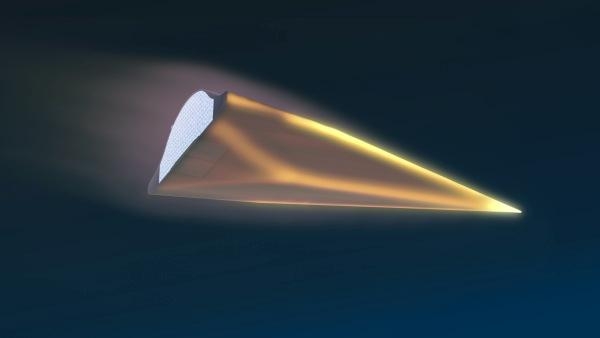
During a test flight Thursday, 11 August, DARPA's Falcon HTV-2
scramjet powered aircraft experienced a flight anomaly post perigee
and into the vehicle's climb. The anomaly prompted the vehicle's
autonomous flight safety system to use the craft's aerodynamic
systems to make a controlled descent and splash down into the
ocean, according to a DARPA news release. Controlled descent is a
term typically associated with a human-in-the-loop directing or
guiding the unscheduled landing of an aircraft. For DARPA's
Hypersonic Technology Vehicle 2 (HTV-2) controlled descent takes on
new meaning thanks to the vehicle's safety system.
"We've confirmed that the HTV-2 made impact with the Pacific
Ocean along its flight trajectory as planned in the event of an
anomaly," explained Air Force Maj. Chris Schulz, DARPA HTV-2
program manager and PhD in aerospace engineering. "This flight
safety system is a significant engineering advance in that the
system prompts a vehicle to monitor the parameters under which it
is operating and exercise safety protocols completely autonomously
should those parameters be breached."
"According to a preliminary review of the data collected prior
to the anomaly encountered by the HTV-2 during its second test
flight," said DARPA Director Regina Dugan, "HTV-2 demonstrated
stable aerodynamically controlled Mach 20 hypersonic flight for
approximately three minutes. It appears that the engineering
changes put into place following the vehicle's first flight test in
April 2010 were effective. We do not yet know the cause of the
anomaly for Flight 2."
A detailed analysis conducted by an independent Engineering
Review Board following the first flight test, prompted engineers to
adjust the vehicle's center of gravity, decrease the angle of
attack flown and use the onboard reaction control systems to
augment vehicle flaps during the vehicle's second flight test.
Those changes appear to have been effective. "An initial assessment
indicates," said Schulz, "that the Flight 2 anomaly is unrelated to
the Flight 1 anomaly."
More News
From 2023 (YouTube Edition): "Ain’t Your Daddy’s Super Cub”—Don Wade Co-owned by Don and Ron Wade—the former of Don’s Dream Machines, a storied >[...]
Pilot-Rated Passenger Reported That The Pilot Did Not Adequately “Round Out” The Landing Flare And The Airplane Bounced And Yawed To The Right Analysis: The pilot state>[...]
Dead Reckoning Dead reckoning, as applied to flying, is the navigation of an airplane solely by means of computations based on airspeed, course, heading, wind direction, and speed,>[...]
Aero Linx: Lake Amphibian Club This website is created and sponsored by the Lake Amphibian Club, to help spread the word about these wonderful, versatile amphibians that can land j>[...]
“I am deeply honored to be sworn in as NASA administrator. NASA’s mission is as imperative and urgent as ever — to push the boundaries of human exploration, ignit>[...]



 Classic Aero-TV: In Praise of Alabamas Patriot Aircraft USA


 See All