Places Orbiter In Better Position For Thermal Emission Imaging
System
The longest-serving of six spacecraft now studying Mars is up to
new tricks for a third two-year extension of its mission to examine
the most Earthlike of known foreign planets. NASA's Mars Odyssey is
altering its orbit to gain even better sensitivity for its infrared
mapping of Martian minerals. During the mission extension through
September 2010, it will also point its camera with more flexibility
than it has ever used before.
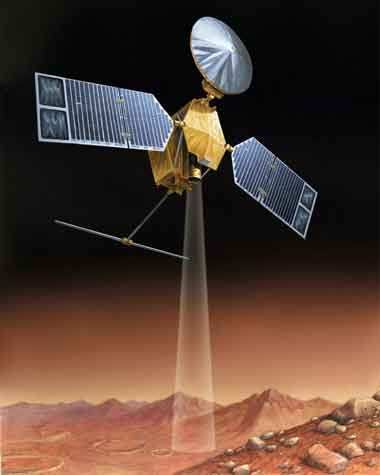
Odyssey reached Mars in 2001. The orbit adjustment will allow
Odyssey's Thermal Emission Imaging System to look down at sites
when it's mid-afternoon, rather than late afternoon. The
multipurpose camera will take advantage of the infrared radiation
emitted by the warmer rocks to provide clues to the rocks'
identities.
"This will allow us to do much more sensitive detection and
mapping of minerals," said Odyssey Project Scientist Jeffrey Plaut
of NASA's Jet Propulsion Laboratory, Pasadena, CA.
The mission's orbit design before now used a compromise between
what works best for the Thermal Emission Imaging System and what
works best for another instrument, the Gamma Ray Spectrometer. On
commands from its operations team at JPL and at Denver-based
Lockheed Martin Space Systems, Odyssey fired thrusters for nearly 6
minutes on September 30, the final day of the mission's second
two-year extension.
 "This was our biggest maneuver since 2002, and it went well,"
said JPL's Gaylon McSmith, Odyssey mission manager. "The spacecraft
is in good health. The propellant supply is adequate for operating
through at least 2015."
"This was our biggest maneuver since 2002, and it went well,"
said JPL's Gaylon McSmith, Odyssey mission manager. "The spacecraft
is in good health. The propellant supply is adequate for operating
through at least 2015."
Odyssey's orbit is synchronized with the sun. The local solar
time has been about 5 pm at whatever spot on Mars Odyssey flew over
as it made its dozen daily passes from between the north pole
region to the south pole region for the past five years. (Likewise,
the local time has been about 5 am under the track of the
spacecraft during the south-to-north leg of each orbit.)
The push imparted by the September 30 maneuver will gradually
change that synchronization over the next year or so. Its effect is
that the time of day on the ground when Odyssey is overhead is now
getting earlier by about 20 seconds per day. A follow-up maneuver,
probably in late 2009 when the overpass time is between 2:30 and
3:00 pm, will end the progression toward earlier times.
While aiding performance of the Thermal Emission Imaging System,
the shift to mid-afternoon is expected to stop the use of one of
three instruments in Odyssey's Gamma Ray Spectrometer suite. The
suite's gamma ray detector needs a later-hour orbit to avoid
overheating of a critical component. The suite's neutron
spectrometer and high-energy neutron detector are expected to keep
operating.
The Gamma Ray Spectrometer provided dramatic discoveries of
water-ice near the surface throughout much of high-latitude Mars,
the impetus for NASA's Phoenix Mars Lander mission. The gamma ray
detector has also mapped global distribution of many elements, such
as iron, silicon and potassium, a high science priority for the
first and second extensions of the Odyssey mission. A panel of
planetary scientists assembled by NASA recommended this year that
Odyssey make the orbit adjustment to get the best science return
from the mission in coming years.
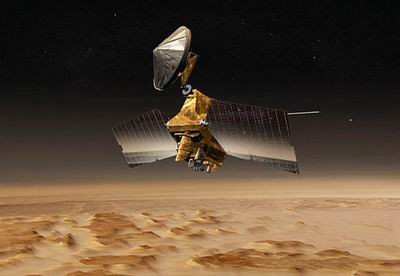
Increased sensitivity for identifying surface minerals is a key
science goal for the mission extension beginning this month. Also,
the Odyssey team plans to begin occasionally aiming the camera away
from the straight-down pointing that has been used throughout the
mission. This will allow the team to fill in some gaps in earlier
mapping and also create some stereo, three-dimensional imaging.
Odyssey will continue providing crucial support for Mars surface
missions as well as conducting its own investigations. It has
relayed to Earth nearly all data returned from NASA rovers Spirit
and Opportunity. It shares with NASA's Mars Reconnaissance Orbiter
the relay role for Phoenix. It has made targeted observations for
evaluating candidate landing sites.



 NTSB Final Report: Patriot Aircraft LLC CX1900A


 See All