

ISS CubeSat Work Proceeds As Crew Landing Moves Up A Day | Aero-News Network
Aero-News Network
RSS icon RSS feed
podcast icon MP3 podcast
Subscribe Aero-News e-mail Newsletter Subscribe

Airborne Unlimited -- Most Recent Daily Episodes

Episode Date

Airborne-Monday

Airborne-Tuesday

Airborne-Wednesday Airborne-Thursday

Airborne-Friday

Airborne On YouTube

Airborne-SpecialEpisode-12.15.25

AirborneNextGen-
12.16.25

Airborne-Unlimited-12.10.25

Airborne-AffordableFlyers-12.11.25

AirborneUnlimited-12.12.25

AFE 2025 LIVE MOSAIC Town Hall (Archived): www.airborne-live.net

Mon, Feb 17, 2014

ISS CubeSat Work Proceeds As Crew Landing Moves Up A Day

Heavy Snow Predicted At Kazakhstan Landing Site Forces Schedule Change

Expedition 38 continued more CubeSat deployments Wednesday morning as the six station residents worked ongoing science and maintenance. Meanwhile, an upcoming landing for a space station trio has moved up one day due to predicted heavy snow at the Kazakhstan landing site.

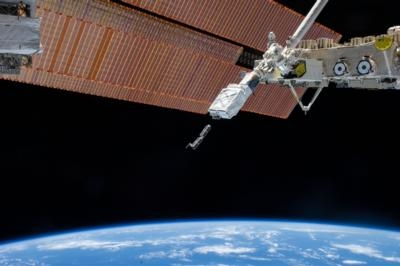
A pair of CubeSats was deployed from the outside of the Kibo laboratory for a second day. However, there were some glitches preventing the deployment of other CubeSats. Japanese flight controllers and U.S. payload controllers are looking at the issue. No decision has been made for rescheduling those deployments.

NASA astronaut Mike Hopkins worked several medical and maintenance tasks during the morning. He checked his blood pressure and conducted an eye exam. He then cleaned and inspected gear inside Europe’s Columbus laboratory.

During most of the afternoon, Hopkins worked on the COLBERT treadmill located in the Unity node. He replaced a failed accelerometer in the exercise device then activated COLBERT for a speed test.

Flight Engineer Rick Mastracchio first assisted Hopkins with the eye exam then exchanged sample cartridges inside the Materials Science Laboratory. After that work, he spent the rest of the afternoon setting up the Microgravity Science Glovebox for the Burning and Suppression of Solids (BASS-II) experiment. BASS-II explores how different substances burn in microgravity with benefits for combustion on Earth and fire safety in space.

Japanese astronaut Koichi Wakata worked throughout Wednesday on the Capillary Flow Experiment-2. The long-running study observes liquids flowing in containers of various shapes to help engineers design better fuel and water transfer systems.

On the Russian side of the station, Commander Oleg Kotov photographed targets for the Seiner Earth observation study. Flight Engineer Sergey Ryazanskiy ran a session of the Bar pressure leak experiment. Veteran cosmonaut Mikhail Tyurin continued more research for the Kulonovskiy Kristall experiment which studies the dynamics of a charged particle system in a magnetic field in microgravity.

The next trio of station residents to go home include Kotov, Ryazanskiy and Hopkins. They will leave a day early due to snowy conditions predicted at the landing zone near Arkalyk, Kazakhstan. They are scheduled to land inside their Soyuz TMA-10 vehicle on March 10 at 11:26 p.m. EST.

Staying behind will be new station commander Wakata and Flight Engineers Mastracchio and Tyurin. They will begin Expedition 39 when their home bound crewmates undock from the Poisk mini-research module about three-and-a-half hours before they land.

(Images provided by NASA. Top: CubeSat deployment. Bottom: Rick Mastracchio is inside the Unity node with floating fresh fruit.)

FMI: www.nasa.gov

Advertisement

More News

ANN's Daily Aero-Term (12.14.25): Local Airport Advisory (LAA)

Local Airport Advisory (LAA) A service available only in Alaska and provided by facilities that are located on the landing airport, have a discrete ground-to-air communication freq>[...]

Airborne 12.08.25: Samaritan’s Purse Hijack, FAA Med Relief, China Rocket Fail

Also: Cosmonaut Kicked Out, Airbus Scales Back, AF Silver Star, Russian A-60 Clobbered A Samaritan’s Purse humanitarian flight was hijacked on Tuesday, December 2, while atte>[...]

ANN's Daily Aero-Linx (12.15.25)

Aero Linx: Michigan Helicopter Association (MHA) The Michigan Helicopter Association (MHA) exists to bring together people who share an interest in helicopters, including private, >[...]

Airborne 12.10.25: New Gulfstream, ATC Integrator, Outrageous FFZ User Fees

Also: Airbus Acquisition, USCG Helo Sniper, Remember Pearl Harbor, New Thunderbird 1 Gulfstream’s newest addition to its next-gen lineup, the super-midsize G300, is officiall>[...]

Airborne-NextGen 12.09.25: Amazon Crash, China Rocket Accident, UAV Black Hawk

Also: Electra Goes Military, Miami Air Taxi, Hypersonics Lab, MagniX HeliStrom Amazon’s Prime Air drones are back in the spotlight after one of its newest MK30 delivery drone>[...]

blog comments powered by Disqus



Advertisement

Advertisement

Podcasts

Advertisement

© 2007 - 2025 Web Development & Design by Pauli Systems, LC

